Olympia was not a mythological title. In 1860s Paris, the name could suggest a courtesan’s adopted persona, which made Manet’s subject feel unmistakably modern.
Witness Olympia by Édouard Manet in Paris – A Modernist Masterpiece
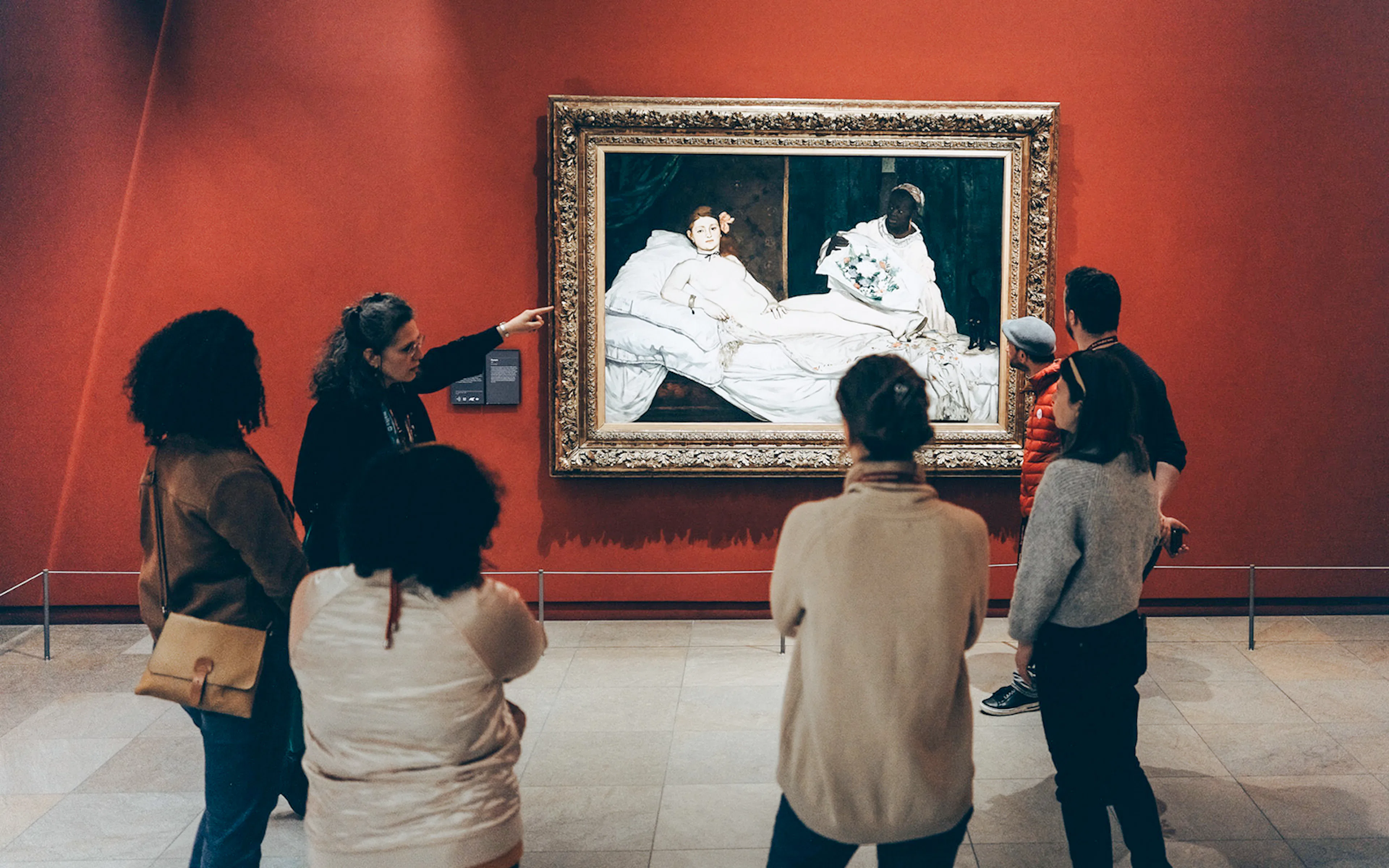
Painted in 1863, Édouard Manet’s Olympia measures 130.5 × 190 cm (51.4 × 74.8 in) yet dominates its gallery through blunt realism, sharp contrasts, and an unflinching stare. Recasting the reclining nude for modern Paris, Manet replaced myth with a recognizably contemporary woman and visible brushwork that unsettled Salon audiences in 1865. See it with reserved entry, an audioguide, or a guided tour for fuller context.
Where is it located?
You’ll find Olympia in the 5th-floor galleries of the Musée d’Orsay in Paris, in the rooms devoted to Manet and the birth of modern painting.
Tickets
Entry is included with a standard Musée d’Orsay ticket; no separate pass is required.
Use a guide for the Salon context
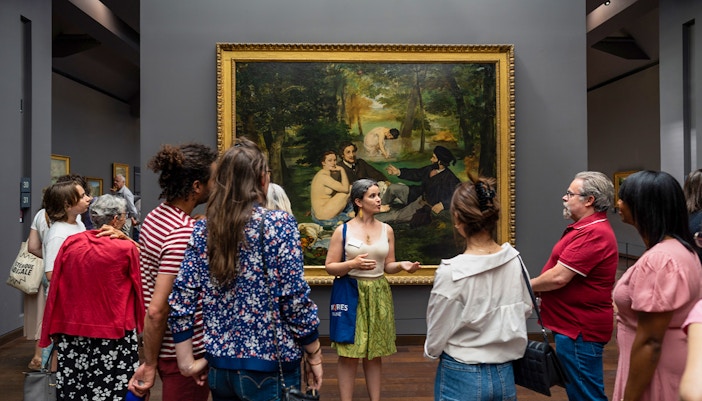
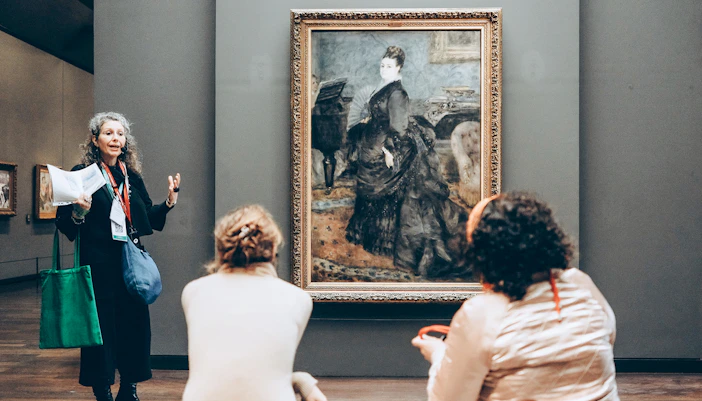
If you want to understand why Olympia caused outrage in 1865, a guided visit helps enormously. Headout options such as the Musée d'Orsay Skip-the-Line Guided Tour, Orsay Museum Guided Impressionist Masterpieces Tour, and Orsay Museum Guided Tour with Fast-Track Tickets place Manet’s painting within the broader story of modern Parisian art.
Start with the full composition
Stand several feet back first so the entire structure reads clearly: the rigid diagonal of Olympia’s body, the dark maid behind her, the bouquet, and the black cat at her feet. From that distance, you can feel how deliberately Manet flattened the space and pushed every element toward the viewer.
Move closer for the brushwork
After taking in the whole canvas, step closer and study the paint surface. Notice how abruptly flesh tones shift from cool to warm, how sharply the white sheets are blocked in, and how little Manet softens outlines compared with older academic nudes.
Visit early or on Thursday evening
The 5th-floor galleries are busiest from late morning into mid-afternoon, when group tours and independent visitors converge around the Impressionist highlights. If you want more breathing room in front of Olympia, aim for opening time or a Thursday evening slot, when the museum’s late closing usually eases the pressure.
Photograph without flash
Personal photography is allowed in the museum, but flash is not. If you’re taking a photo of Olympia, wait for a gap in the crowd and frame the painting straight on; this keeps the bouquet, maid, and cat legible rather than flattening them into a dark background.
Pair it with nearby Manets
Don’t stop at a single canvas. After Olympia, seek out Manet’s Luncheon on the Grass and The Balcony to see how consistently he challenged academic painting through modern subjects, compressed space, and psychologically charged figures.
Did you know?
A loaded name
Painted before the scandal
Manet completed Olympia in 1863, but the public first saw it at the Salon of 1865. That gap did nothing to soften the shock.
Victorine Meurent was more than Manet’s model
The woman in Olympia is widely identified as Victorine Meurent, who also appears in Manet’s Luncheon on the Grass. She later built her own career as a painter and exhibited at the Salon herself.
The cat changed the meaning
Earlier reclining nudes often included a loyal lapdog as a sign of fidelity. Manet replaced that symbol with an alert black cat, adding nervous energy and erotic tension.
The accessories were deliberate
The orchid in Olympia’s hair, the bracelet, the ribbon around her neck, the mules, and the bouquet all anchored the scene in contemporary Paris rather than in an idealized classical past.
It needed protection at the Salon
The reaction in 1865 was so hostile that attendants had to keep close watch as crowds gathered to mock the painting. Few works of the period provoked that level of public agitation.
Monet helped secure it for France
In 1890, Claude Monet helped organize a public subscription so the French state could acquire Olympia. That campaign helped transform a scandalous canvas into national heritage.
It reached the Musée d’Orsay only in 1986
Before arriving at the Musée d’Orsay, Olympia passed through the Musée du Luxembourg, the Louvre, and the Jeu de Paume. Its current home is the result of a long institutional journey.
Story behind *Olympia*
A modern nude takes shape
Manet painted Olympia in 1863, using the structure of earlier reclining nudes but stripping away their mythological cover. Instead of a timeless Venus, he showed a contemporary woman with recognizable signs of wealth, labor, and exchange. The result was not simply provocative subject matter, but a direct confrontation with modern Paris.
A challenge to old ideals
The painting’s dialogue with Titian’s Venus of Urbino was deliberate. Manet kept the reclining pose, the attendant figure, and the interior setting, but changed their meaning entirely. His nude does not drift into fantasy or invitation; she looks back with full awareness, making the viewer newly self-conscious.
The Salon storm of 1865
When Olympia appeared at the Salon in 1865, critics and visitors reacted with ridicule, anger, and moral panic. Many viewers were less offended by nudity itself than by the sense that Manet had painted a present-day sex worker without idealizing her. His flat lighting, hard outlines, and exposed brushwork made the break with academic polish even more visible.
From outrage to public treasure
What scandalized one generation became indispensable to the next. In 1890, friends and admirers, including Claude Monet, helped raise funds so the French state could acquire the work. That rescue ensured Olympia would remain in public hands rather than disappear into a private collection.
A foundation stone of modern art
Over time, Olympia came to represent a decisive break in Western painting. Manet refused smooth illusion, softened allegory, and inherited beauty on old terms; instead, he presented modern life with all its discomforts intact. That is why the painting now stands not only as a famous scandal, but as one of the clearest starting points for modern art.
Who created *Olympia*?
Édouard Manet (1832–1883) was a French painter whose work bridged Realism and the beginnings of modern art. Although closely associated with the generation that inspired Impressionism, he worked outside the movement’s formal exhibitions and pursued a sharper, more confrontational vision of contemporary Paris, with subjects drawn from urban life and modern spectatorship. In Olympia, Manet used broad brushwork, compressed space, and stark tonal contrasts to strip the traditional reclining nude of mythological distance. The result was deliberately modern: a painting that made viewers face class, sexuality, race, and the economics of looking. This approach also animates Luncheon on the Grass, A Bar at the Folies-Bergère, and The Fifer, works that similarly challenged academic expectations. Manet’s legacy lies not only in what he painted, but in how he painted it—flattening form, exposing technique, and opening the door for artists from Degas to Picasso.
What makes *Olympia* a masterpiece? See for yourself
1/6
The direct gaze
Olympia does not avert her eyes or dissolve into dreaminess. She looks back at the viewer with composure and control, changing the emotional balance of the painting and making the act of looking part of the subject itself.
The modern body
Manet rejected the polished ideal body expected in academic nudes. Her form is more abrupt, more angular, and more real, which is exactly why the painting felt so contemporary and unsettling to 19th-century audiences.
The charged supporting cast
The maid, the bouquet, and the black cat are not decorative extras. Together they suggest social exchange, class difference, erotic commerce, and tension, turning what could have been a conventional nude into a scene dense with modern meaning.
The pared-back space
The room around Olympia is shallow and compressed, with little atmospheric depth to soften the confrontation. This pushes the figure forward and makes the canvas feel immediate, almost blunt, when you stand in front of it.
The exposed brushwork
Look closely at the sheets, the flowers, and the flesh tones. Manet leaves strokes visible and transitions abrupt, refusing the smooth finish that academic painting prized and making the painting’s surface part of its modern force.
The break with tradition
Olympia borrows the framework of Titian’s reclining Venus but overturns its message. What had once been a sensual, idealized nude becomes a self-aware figure in modern Paris, and that reversal helped redefine what painting could do.
Frequently asked questions about *Olympia*
No. Olympia is included with standard Musée d’Orsay admission, including reserved-access tickets and guided tours.
It is displayed in the 5th-floor galleries of the Musée d’Orsay, in the rooms devoted to Manet and modern painting.
Manet showed a contemporary nude with direct eye contact and signs linked to prostitution, not a safely mythological goddess.
Yes. Personal photography is allowed, but flash, tripods, selfie sticks, and professional equipment are not permitted.
Right after opening or on Thursday evening, when the 5th-floor galleries are usually calmer than midday.
Give it 15–20 minutes, then add 20–30 minutes for nearby Manet works that deepen its context.
Yes. It helps explain the Salon scandal, Manet’s technique, and the painting’s break from older nude traditions.
Look for Manet’s Luncheon on the Grass and The Balcony, plus nearby works by Degas, Monet, and Cézanne.
More reads
Orsay Museum Reserved Access Tickets
Musée d'Orsay Skip-the-Line Guided Tour
Orsay Museum Guided Impressionist Masterpieces Tour