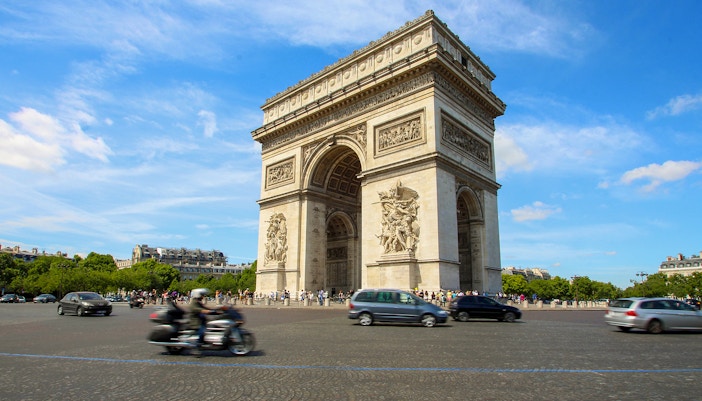
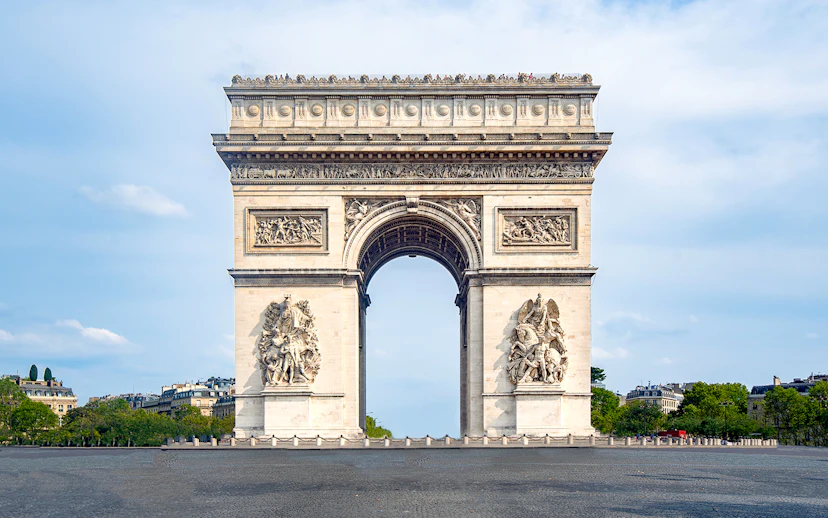
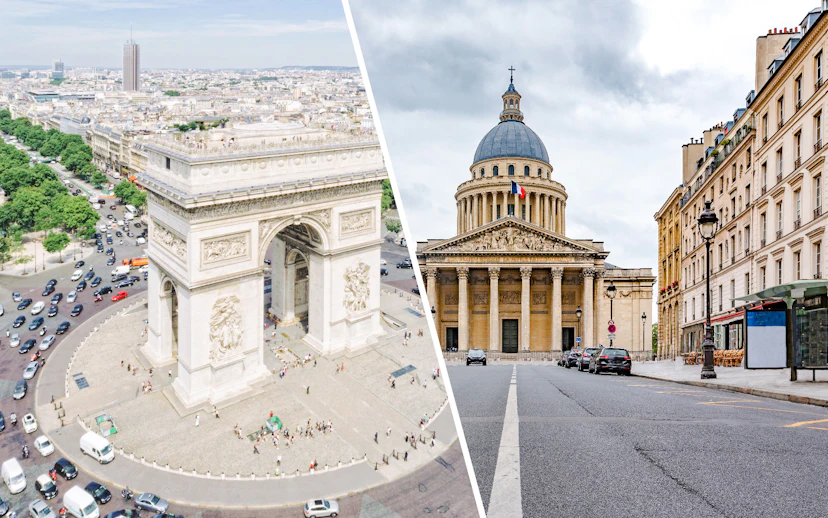
- What you’ll see: Four monumental sculptural groups carved around the Arc’s pillars.
- Look out for: François Rude’s La Marseillaise, showing volunteers answering the call to defend France.
- Why it matters: Together, the sculptures represent revolution, Napoleon’s triumph, resistance to invasion, and the return of peace.
Inside the Arc de Triomphe | Memorial, museum, staircase & rooftop
From the Champs-Élysées, the Arc de Triomphe is all scale and sculpture. Step beneath and inside it, and the experience becomes more personal: names of soldiers cover the stone, the Tomb of the Unknown Soldier sits beneath the arch, and a spiral staircase leads through a small museum to the rooftop.
- Don’t miss: The memorial, inscriptions, museum and rooftop.
- Look up: The coffered vault is one of the easiest details to walk straight past.
- Pro tip: Start at ground level and work your way up—the rooftop makes a natural finale.
What’s inside the Arc de Triomphe?
From the street, the Arc de Triomphe is all scale and sculpture. Get closer and the details start to take over: memorials beneath the arch, names carved across the stone, a museum tucked inside, and a spiral climb that ends with Paris spread out below.
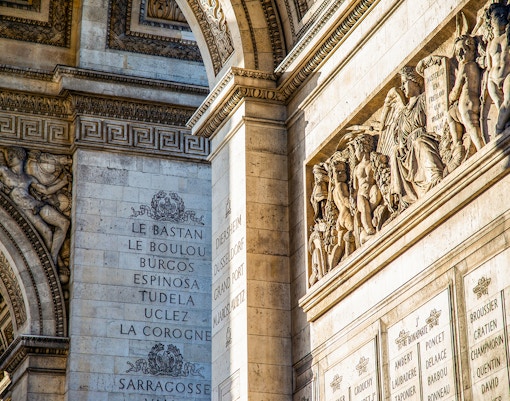
Sculptures and reliefs

Tomb of the Unknown Soldier
- Where: Directly beneath the central arch.
- What you’ll see: The tomb dedicated to unidentified French soldiers who died during World War I.
- Why it matters: This is where the Arc shifts from a monument celebrating military triumph to a place of national remembrance.

The Eternal Flame
- Where: Beside the Tomb of the Unknown Soldier.
- What to know: First lit in 1923, the flame is ceremonially rekindled every evening at 6:30pm.
- Why it matters: The daily ceremony keeps the memorial active rather than leaving it as a purely historical feature.

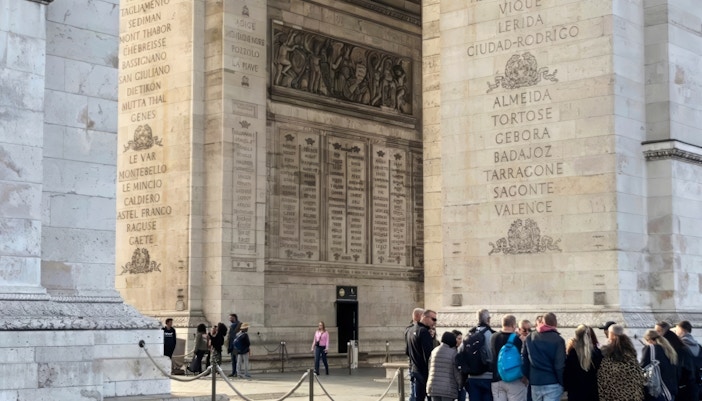
Historical inscriptions
- What you’ll see: Rows of French generals’ names and military references carved across the Arc’s stone surfaces.
- Look closely: Some names are underlined, identifying officers who died on the battlefield.
- Why it matters: The inscriptions turn the monument itself into a record of France’s Revolutionary and Napoleonic military history.

The coffered vault
- Where: Look directly above you while standing beneath the central arch.
- What you’ll see: Geometric coffers and carved rosettes covering the vaulted ceiling.
- Don’t miss: These details are almost invisible from across Place Charles de Gaulle, so this is one feature you can only properly appreciate up close.

The museum
- Where: On the mezzanine level, partway through the climb.
- What you’ll see: Displays covering the Arc’s construction, sculptures, history, and changing role in French national life.
- Why stop: It connects the memorials and details you’ve already seen with the story behind the monument before you continue upwards.

The spiral staircase
- What to expect: A 240-step spiral staircase takes you towards the museum level, followed by roughly 40 more steps to the terrace.
- Why it stands out: The tightly enclosed climb makes the moment you step onto the open rooftop feel even more dramatic.
- Know more: Explore the Arc de Triomphe stairs & elevator.

The rooftop terrace
- What you’ll see: 360° views across Paris, including the Eiffel Tower, Sacré-Cœur, Champs-Élysées, and La Défense.
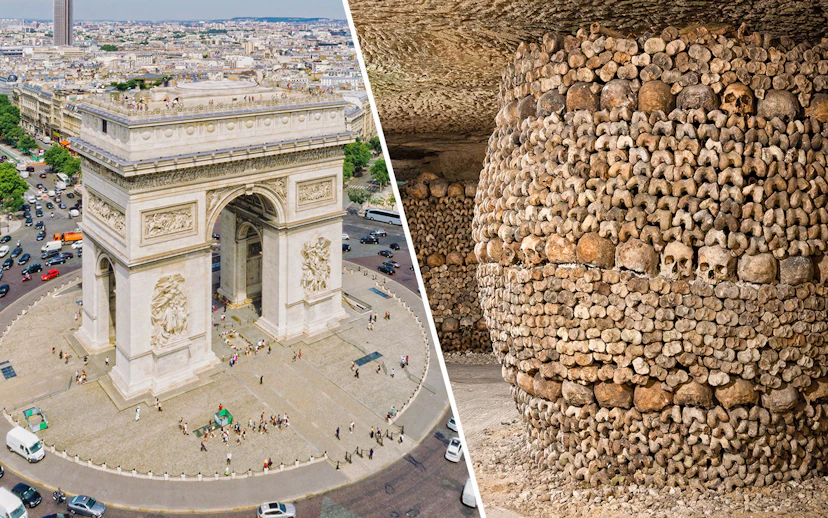
- Look down: The avenues radiating from Place Charles de Gaulle reveal why the square was known as Place de l’Étoile.
- Tip: Walk the full terrace—the skyline changes with every side.
- Know more: Explore Arc de Triomphe rooftop & views.
How the experience flows
You don’t need a complicated route here. Start outside with the sculptures, move beneath the arch for the Tomb of the Unknown Soldier, Eternal Flame, inscriptions, and vaulted ceiling, then head inside to the museum. From there, continue upwards and save the rooftop for last.
This gives the visit a natural progression: military triumph → remembrance → history → Paris views.
What’s the traffic around the Arc de Triomphe like?
- It’s not a pedestrian crossing: Don’t attempt to walk across the traffic lanes to reach the Arc. Use the underground Passage du Souvenir, accessible from the Champs-Élysées and Avenue de la Grande Armée sides.
- Driving can be tricky: Place Charles de Gaulle is a large, busy junction where 12 avenues meet. If you’re unfamiliar with driving in Paris, Metro or RER is the simpler option for reaching the monument.
- The rooftop gives you the best perspective: Look straight down to see the avenues radiating from the Arc like spokes. This star-shaped layout explains the square’s historic name, Place de l’Étoile, or “Square of the Star.”
- Major events can affect access: Ceremonies and events around the Arc can lead to road restrictions, security perimeters, or temporary public-transport changes. Check same-day conditions if you're visiting during a major event.
Good to know: The traffic is something to look at, not navigate on foot—use the underpass to reach the monument, then head to the rooftop if you want to see the full star-shaped layout from above.
Frequently asked questions about the inside of the Arc de Triomphe
Starting from the outside, you’ll see four sculpted groups on pedestals. Step into the archway and you’ll find a wall of inscriptions (names of military generals), climb to the museum on the mezzanine level, and wrap up your visit on the rooftop.
Yes, there are no restrictions on taking photographs of and with the monument.
There are 284 steps to the top, so be prepared for a bit of a climb!
The rooftop offers panoramic views of Paris, including the Champs-Élysées, Eiffel Tower, and Sacré-Cœur.
Yes, a small museum on the mezzanine floor showcases the monument's history and significance through artifacts and multimedia.
No, the Eternal Flame is located at the base of the arch, accessible from the outside only.
The interior is partially accessible, with an elevator available, but the rooftop remains inaccessible for wheelchairs.
There is limited seating inside, primarily in the museum area.
Most visitors spend around 1–1.5 hours exploring the museum and rooftop.
Yes, it remains open, but access to the rooftop may be restricted in extreme weather conditions.