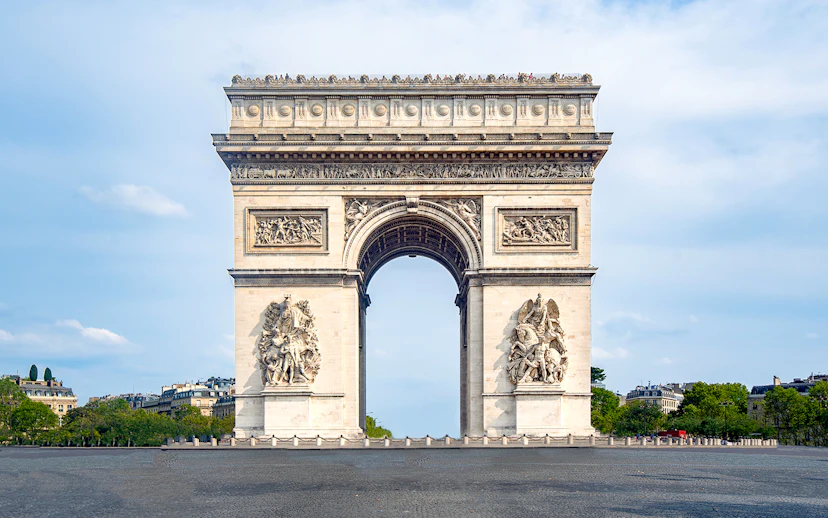
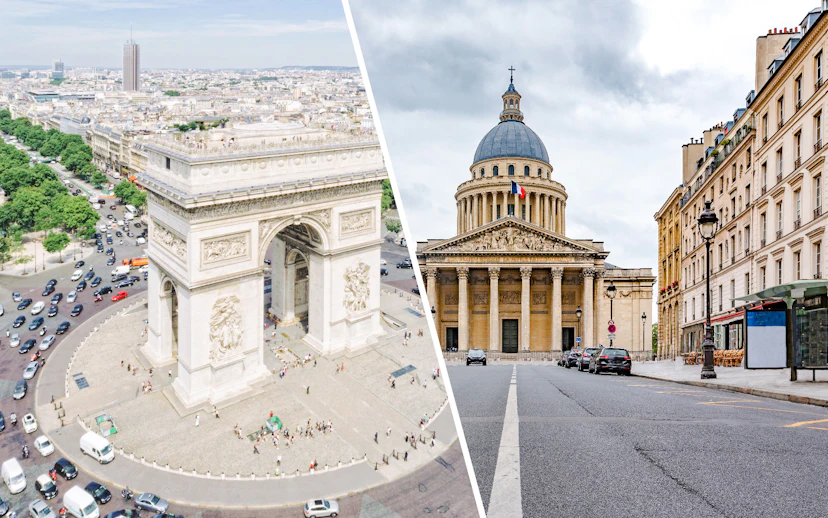
- Roman triumphal form: Its huge central arch draws directly from the triumphal monuments ancient Romans built to celebrate military victories.
- Strong symmetry: Four massive pillars, balanced proportions, and clean lines give the monument its ordered, imposing appearance.
- Monumental scale: At 50m high, the Arc uses sheer size to communicate strength and permanence.
- Classical details: Friezes, reliefs, and the coffered vault borrow architectural elements associated with ancient Roman monuments.
- French storytelling: Sculptures such as La Marseillaise, battle scenes, and engraved names turn the Roman-inspired structure into a monument to French history.
- More than decoration: Napoleon deliberately chose this classical language to connect his military victories with the prestige and power of ancient Rome.
Arc de Triomphe architecture: Design, sculptures & construction
Architecture at a glance
- Style: Neoclassical, inspired by ancient Roman triumphal arches.
- Architect: Jean-François-Thérèse Chalgrin led the original design.
- Construction: Built between 1806 and 1836.
- Size: 50m high and 45m wide.
- Material: Primarily limestone.
- Key features: Four massive pillars, sculptural groups, battle reliefs, friezes, inscriptions and a coffered vault.
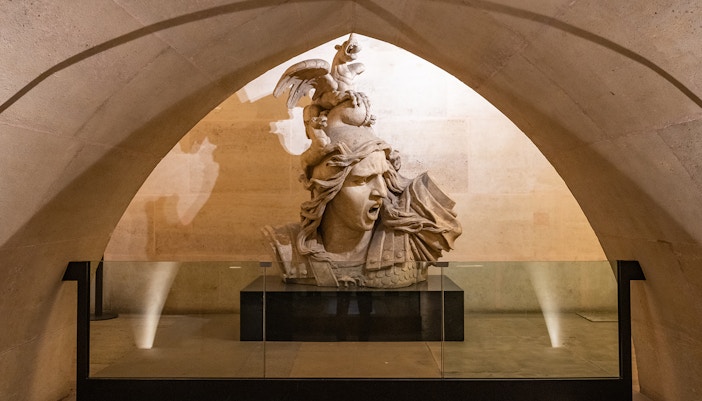
- Standout detail: François Rude’s La Marseillaise adds a burst of movement to the Arc’s otherwise highly symmetrical design.
What makes the Arc de Triomphe Neoclassical?
The Arc de Triomphe takes the visual language of ancient Rome and gives it a distinctly French identity. Look closely and the Neoclassical influences become easy to spot:
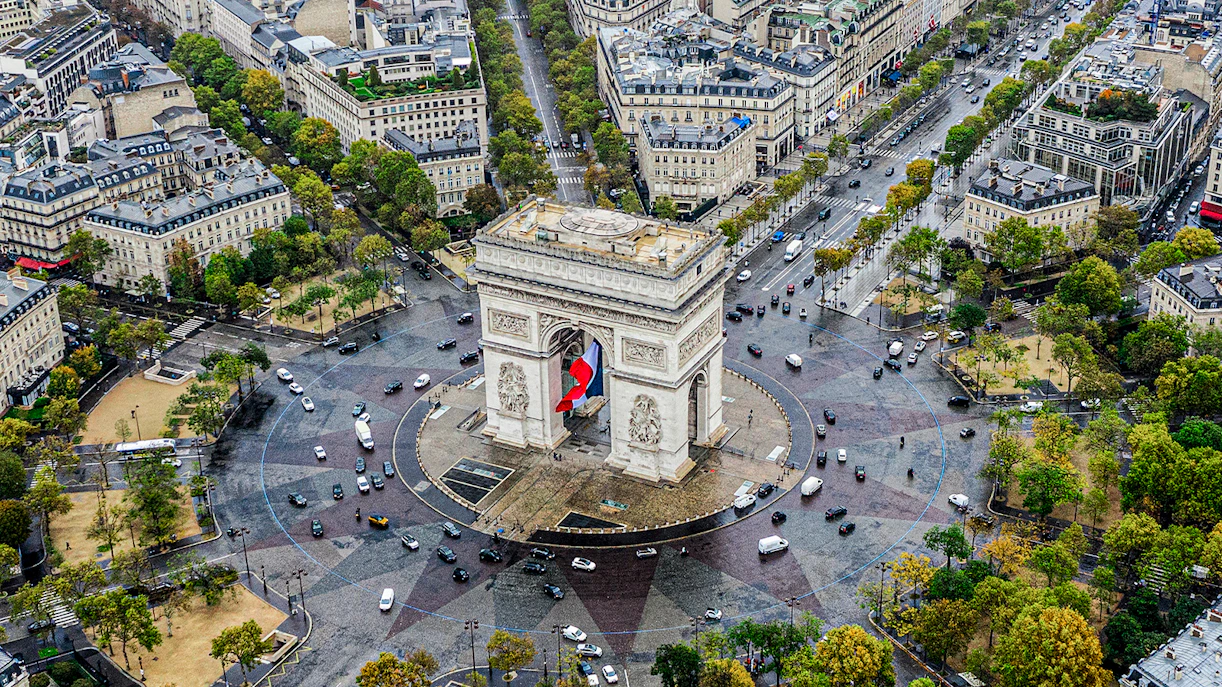
In short: Roman proportions and symmetry provide the structure; French sculpture and symbolism give the Arc its identity.
Look closer: the Arc's architecture
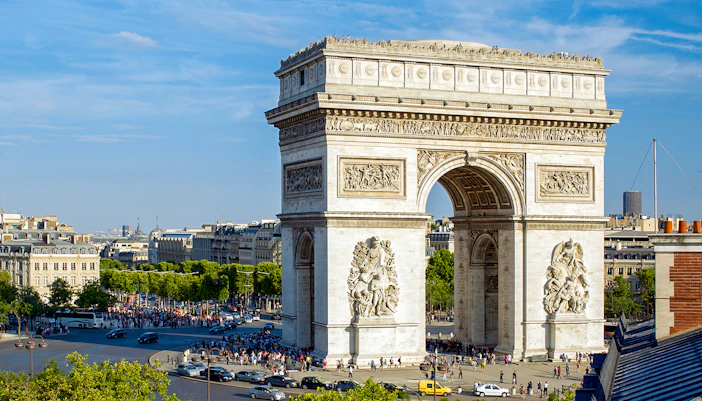
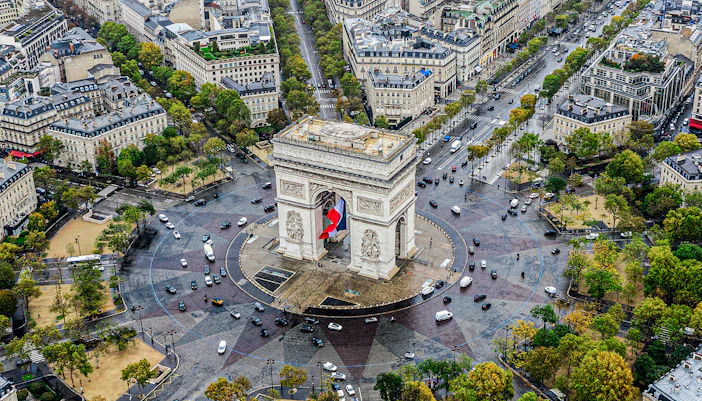
The monumental arch
At 50m high and 45m wide, the Arc was designed to dominate its surroundings. Its huge central opening and symmetrical proportions give the monument its unmistakable silhouette—even before you notice the sculptures covering its pillars.
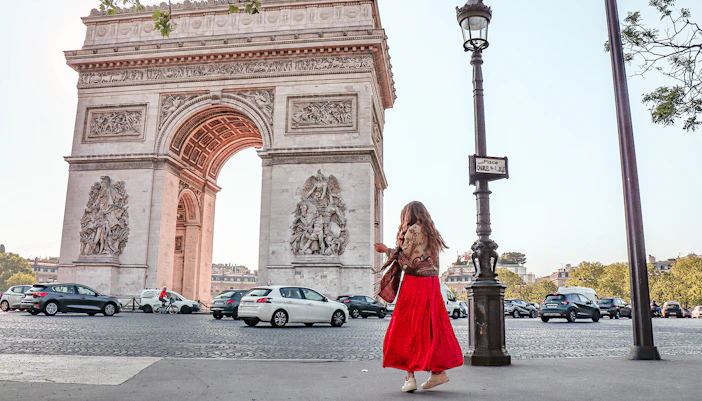
The four pillars
The pillars aren't just structural. Each becomes a huge canvas for sculpture, with four monumental groups representing defining moments between the French Revolution and the end of the Napoleonic era.
The coffered vault
Walk underneath the Arc and remember to look up. The vaulted ceiling is filled with geometric coffers and carved rosettes—a surprisingly intricate detail hidden inside the monument's otherwise imposing stone structure.

The friezes and reliefs
Battle scenes and allegorical figures stretch across the façades, turning the Arc into a story told in stone. They soften its clean Neoclassical lines while reinforcing the military purpose behind the monument.

The inscriptions
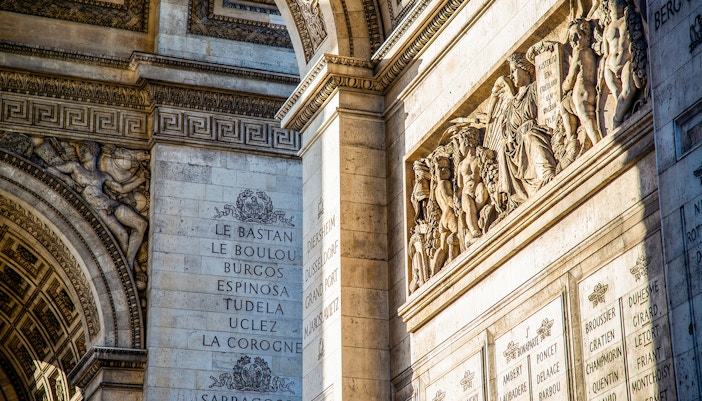
Names of French generals and battles are carved across the Arc’s inner surfaces, turning the monument into a vast record of the Revolutionary and Napoleonic wars. Look closely and you’ll notice that some names are underlined, marking officers who died in battle. The inscriptions are easy to miss from a distance, but up close they add another layer to the Arc’s design, blending decoration with commemoration.
The upper level
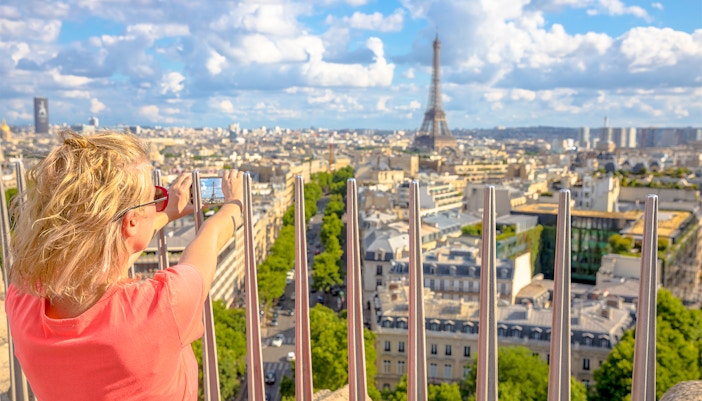
The attic forms the Arc’s uppermost architectural section, giving the monument its strong horizontal finish above the main vault. Inside, it contains exhibition and circulation spaces that lead towards the terrace. From the outside, this upper level helps balance the Arc’s massive pillars and central opening, while keeping the overall silhouette clean and symmetrical.
Meet the sculptures on the Arc de Triomphe
La Marseillaise | The Departure of the Volunteers of 1792
François Rude's most recognisable group is also the most energetic. A winged figure of Liberty calls volunteers into battle, with twisting bodies and dramatic expressions capturing the revolutionary call to defend France.
The Triumph of 1810
Jean-Pierre Cortot puts Napoleon at the centre, crowned by Victory and surrounded by allegorical figures. The composition celebrates both his military successes and the achievements associated with his rule.
The Resistance of 1814
Antoine Étex shifts the mood from victory to defence. A warrior protecting his family represents France's resistance during the Allied invasion of 1814.
The Peace of 1815
Étex's companion piece brings the sequence to a quieter close. A warrior returns his sword to its scabbard as surrounding figures represent the return of peace and prosperity.
Design and construction of the Arc de Triomphe
Who designed the Arc de Triomphe?
Jean-François-Thérèse Chalgrin shaped the original design, working initially alongside Jean-Arnaud Raymond. Chalgrin died before seeing it completed, so architects including Louis-Robert Goust and Jean-Nicolas Huyot continued the project over its three-decade construction.
How was the Arc de Triomphe built?
Built from massive blocks of limestone, the Arc combines precise masonry with the clean symmetry of a Roman triumphal arch. Its self-supporting structure channels weight through the surrounding masonry, while the vaulted ceiling adds both strength and carved detail. Sculptures and reliefs were then integrated into the façades, turning the structure itself into part engineering feat, part visual storytelling.
Frequently asked questions about Arc de Triomphe’s architecture
The Arc de Triomphe is Neoclassical, drawing heavily on the symmetry, proportions, and monumental forms of ancient Roman triumphal arches.
Jean-François-Thérèse Chalgrin led the original design, initially working with Jean-Arnaud Raymond. After Chalgrin’s death, other architects continued the project until its completion in 1836.
Its design was inspired by ancient Roman triumphal arches, particularly the tradition of building monumental gateways to commemorate military victories.
The monument is built primarily from limestone masonry, with its large stone surfaces providing the backdrop for sculptures, reliefs, friezes, and inscriptions.
The Arc stands approximately 50m high and 45m wide, with a monumental central arch dominating its symmetrical façade.
The four monumental groups represent key moments in French history: The Departure of the Volunteers of 1792 (La Marseillaise), The Triumph of 1810, The Resistance of 1814, and The Peace of 1815.
Yes, the Arc has undergone periodic restorations to preserve its carvings and structural integrity, especially against weathering.
Yes, guided tours delve into the history and architectural details of the arch. You can also combine it with a walking neighborhood tour for better contextual reference.
The Arc is inscribed with the names of French generals and military victories from the Revolutionary and Napoleonic wars. Some generals’ names are underlined to indicate that they died in battle.
Napoleon wanted a monument that would celebrate the achievements of the French army. Using the form of a Roman triumphal arch connected his vision with the ancient tradition of commemorating military victories through monumental architecture.