Budget 90 minutes for the permanent collection alone, or 2–3 hours if you’re also seeing the temporary exhibition and pausing at the Dufy and Matisse rooms rather than moving through them quickly. Start with the main chronological galleries so the movements unfold clearly — Fauvism into Cubism, then later modernism — and save Salle Dufy and Salle Matisse for the middle of your visit, when you have enough context to appreciate their scale. If the temporary exhibition is included in your ticket, finish there; it works best after the permanent collection has oriented your eye.
You step in from the Seine-facing terrace into bright galleries where color hits fast — Matisse with rhythm, Delaunay with circles, Dufy with electric shimmer. It feels airy rather than solemn, with enough space to actually stand still in front of a canvas.
The museum occupies the eastern wing of the 1937 Palais de Tokyo, built when Paris wanted to present itself as a modern cultural capital. That origin still matters: this collection shows how radically art changed in the 20th century, and how Paris helped drive that shift.
What stays with most visitors is the contrast between intimacy and scale — one room gives you a quiet Modigliani portrait, the next wraps you in Dufy’s vast mural.
Skip it if: you only care about household-name masterpieces and have under an hour near the Eiffel Tower.
What to see at the Museum of Modern Art Paris?
1/8
The chronological collection rooms
Start here to understand the museum’s logic: Fauvism, Cubism, Surrealism, and later abstraction unfold room by room. It’s the best orientation point for first-timers and helps the mural rooms land with much more force.
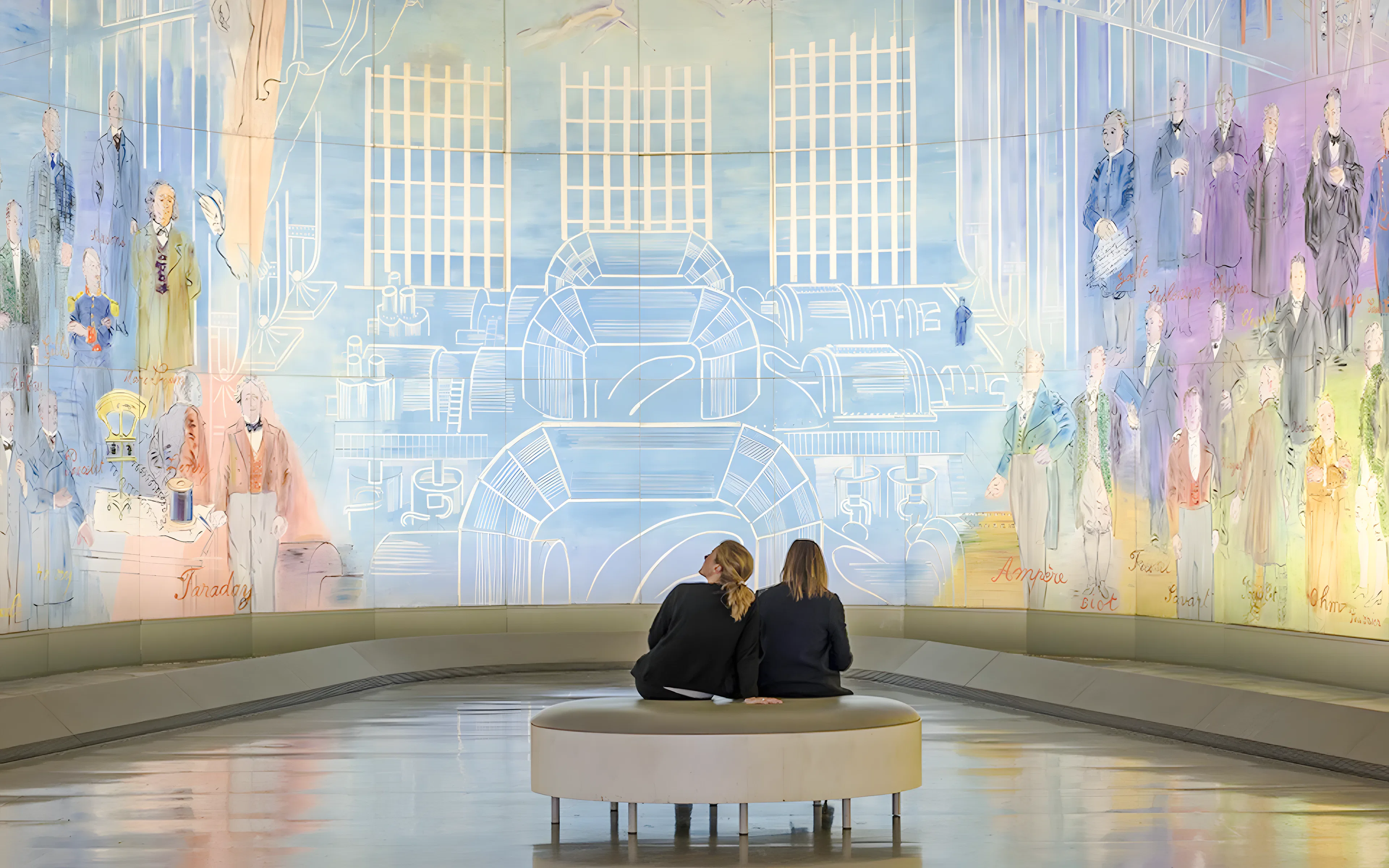
Salle Dufy
Raoul Dufy’s La Fée Électricité fills an entire space with color, science, and spectacle. Budget real time here; people often linger longer than planned because the mural keeps revealing new details across its vast surface.
Salle Matisse
This gallery centers on Matisse’s La Danse (Paris), shown in the architectural context it was created for. The scale matters as much as the painting itself, so stand back first, then move closer.
Cubism and School of Paris rooms
These galleries bring together Picasso, Braque, Léger, Modigliani, and others who shaped Parisian modernism. They are less crowded than the Louvre or Orsay, which makes looking slowly much easier.
Delaunay and abstraction galleries
Robert and Sonia Delaunay’s work gives the collection some of its strongest energy. These rooms are where color, rhythm, and urban modernity come together most clearly, especially if you’re interested in how Paris imagined itself.
Postwar rooms and Yves Klein
The later galleries shift the mood from early modern experimentation to sharper postwar statements. Yves Klein’s blue monochromes are a standout, especially after the busier earlier rooms full of competing color and movement.
Temporary exhibition galleries
These rotating shows are where current demand concentrates. If a major retrospective is on, book ahead; blockbuster exhibitions here can draw huge crowds even when the free permanent collection remains relatively calm.
The terrace and Eiffel Tower view
Step outside before leaving. The setting is part of the experience, with broad terraces, Seine views, and a direct visual link to the Eiffel Tower that makes the museum feel woven into the city.
How to explore the Museum of Modern Art Paris

Plan your time and route
What to prioritize
Must-see: Salle Dufy, Salle Matisse, and the rooms with Picasso, Braque, Sonia and Robert Delaunay, and Yves Klein.
Optional: the terrace views and a stop at neighboring Palais de Tokyo add atmosphere and context, but together can add 45–60 minutes.
A guided tour adds real value here because the permanent collection is strong but not over-explained; a good guide helps connect movements, commissions, and the building itself. Self-paced works well if you’ve already chosen a few artists to follow.
Brief history of the Museum of Modern Art
- 1937: The Palais de Tokyo is built for the International Exhibition, giving Paris a grand Art Deco venue for modern cultural display.
- 1961: The eastern wing formally opens as the Musée d’Art Moderne de Paris, dedicated to 20th-century art.
- 20th century: The collection expands through city acquisitions, donations, and major deposits, growing into one of France’s strongest municipal modern art holdings.
- 1964: Raoul Dufy’s La Fée Électricité is installed permanently and becomes one of the museum’s defining works.
- 2019: After a major renovation, the museum reopens with refreshed galleries and improved visitor facilities.
- Today: The museum pairs free permanent galleries with ticketed temporary exhibitions that regularly draw large audiences.
Architecture of the Museum of Modern Art Paris
Style
Art Deco classicism. The long colonnade and restrained ornament make the approach feel ceremonial before you even enter.
Materials
Pale stone, sculpted reliefs, metal details, and polished interior surfaces keep the building bright, crisp, and unmistakably 1930s.
Structure
Built for the 1937 International Exhibition, the palace uses broad halls and generous circulation spaces that let monumental works like Dufy’s mural breathe.
On the ground
Inside, the rhythm shifts from grand staircases to quieter galleries; outside, the terraces open toward the Seine and Eiffel Tower.
Architects
Jean-Claude Dondel, André Aubert, Paul Viard, and Marcel Dastugue designed the Palais de Tokyo as a civic showcase for modern Paris.
Who built the Museum of Modern Art?
The museum occupies the eastern wing of the Palais de Tokyo, commissioned for the 1937 International Exhibition when Paris wanted architecture that looked civic, modern, and monumental at once. The later museum inherited that ambition, turning a world’s fair showpiece into a public home for 20th-century art.
Additional Information about Museum of Modern Art
Because the permanent collection is free, the museum has a stronger local rhythm than many Paris institutions. You’ll see students sketching, Parisians dropping in for an hour, and visitors treating the museum as part of a neighborhood day rather than a major logistical event. That changes the atmosphere. Even when a temporary exhibition is busy, the permanent galleries often feel calmer and less choreographed than the Louvre or Musée d’Orsay. If you want to see major 20th-century art without spending half your visit navigating crowds, that local, lived-in quality is part of the appeal.
Frequently asked questions about the Musée d’Art Moderne de Paris
Yes, especially if you like 20th-century art and want a serious museum near the Eiffel Tower without Louvre-level crowds. The permanent collection is free, so even a short visit has a strong payoff.
Most visitors spend 90 minutes in the permanent collection and 2–3 hours if they add the temporary exhibition. If you’re combining it with the Eiffel Tower or a Seine cruise, treat it as a half-day rather than a quick stop.
Do not leave without seeing Salle Dufy for La Fée Électricité and Salle Matisse for La Danse. After that, prioritize the Picasso, Braque, Delaunay, and Yves Klein rooms; they give the clearest sense of the collection’s range.
Yes, for all three. First-timers benefit from the clear gallery flow, and families appreciate the manageable size, free permanent entry, and stroller-friendly spaces. Younger children usually respond best to the mural rooms and wide-open galleries.
No for the permanent collection, but yes for temporary exhibitions if you’re visiting during a major show or building a same-day Eiffel Tower combo. Timed tickets reduce uncertainty and are the better choice during busy periods.
Weekday mornings and Thursday evenings are your best bets for quieter galleries. Summer afternoons and blockbuster exhibition weekends are the busiest. If you’re pairing the museum with the Eiffel Tower, visit the museum first, then head outside.

