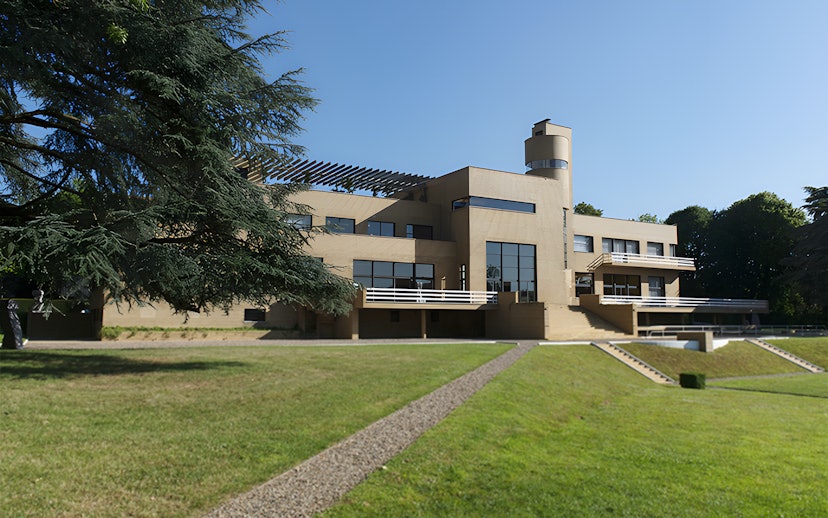
Visiting Villa Cavrois: your complete guide
Villa Cavrois is a restored 1930s modernist house museum best known for Robert Mallet-Stevens's radical design and the long reflecting pool behind it. The visit is manageable in size, but it rewards slow looking more than rushing from room to room because many of the smartest details are in how light, furniture, and family spaces were planned together. The biggest difference between a flat visit and a memorable one is doing the interiors before the gardens. This guide covers timing, arrival, tickets, route, and what to prioritize.
Quick overview: Villa Cavrois at a glance
If you only read one section before booking, make it this one.
- When to visit: Tuesday–Sunday, 10am–6pm. Weekday late mornings in November–March are noticeably calmer than weekend afternoons in June–September, because most local visitors come in the warmer months and free-entry Sundays pull extra winter crowds.
- Getting in: From €11 for standard entry. Guided visits are offered on select dates rather than as a daily add-on, so booking ahead matters most for summer weekends, special tours, and European Heritage Days.
- How long to allow: 1–2 hours works for most visitors. It stretches toward 2 hours if you watch the restoration film, linger in the family rooms, and walk the gardens properly.
- What most people miss: The children's wing and dining room add real personality to the house, and the restoration film makes the stripped-back rooms far more meaningful.
- Is a guide worth it? Yes, if you care about architecture, restoration, or how the house actually worked; if you mainly want the spaces and photos, a self-guided visit with the booklet is enough.
🎟️ Weekend slots for Villa Cavrois can disappear a few days ahead in July, August, and during Heritage Days. Lock in your visit before the time you want is gone. See ticket options
Jump to what you need
🕒 Where and when to go
🎟️ Which ticket is right for you?
🗺️ Getting around
🏛️ What to see
♿ Facilities and accessibility
Where and when to go
How do you get to Villa Cavrois?
Villa Cavrois is in Croix, a quiet residential suburb in the Lille metropolitan area, about 10km from central Lille and a short walk from the local tram stop.
60 avenue John Fitzgerald Kennedy, 59170 Croix, France
- Tram: Villa Cavrois stop on the Lille–Roubaix line → 10-minute walk → follow the residential route toward Avenue John Fitzgerald Kennedy.
- Train + tram: From Lille Europe or Lille Flandres → connect to the tram toward Roubaix → simplest option if you are not driving.
- Taxi / rideshare: Drop-off at the main gate on Avenue John Fitzgerald Kennedy → easiest if you are short on time.
- Car: Free parking lot by the Jardins Mallet-Stevens → 5–6-minute walk → useful on weekdays, but it can fill on busy summer afternoons.
Which entrance should you use?
There is one main visitor entrance, and the mistake most people make is assuming they can wander in whenever they like without thinking about their timed slot.
- Main entrance: Located off Avenue John Fitzgerald Kennedy at the reception area. Expect 5–15 minutes' wait on summer weekends, free-entry Sundays, and Heritage Days.
When is Villa Cavrois open?
- Tuesday–Sunday: 10am–6pm
- Monday: Closed
- January 1, May 1, and December 25: Closed
- Last entry: 5:15pm
When is it busiest? Weekend afternoons from June to September, plus the first Sunday of winter free-entry months and European Heritage Days, feel the most crowded in the salons and around the reflecting pool.
When should you actually go? A Tuesday or Thursday between 10:30am and 12 noon usually gives you the calmest interiors, because group visits and local leisure traffic tend to build later in the day.
Which Villa Cavrois ticket is best for you
| Ticket type | What's included | Best for | Price range |
|---|---|---|---|
Villa Cavrois Tickets | Entry to Villa Cavrois | A straightforward self-guided visit where you want guaranteed entry and enough flexibility to move through the house and gardens at your own pace | From €11 |
How do you get around Villa Cavrois?
Villa Cavrois is a compact, mostly linear house museum spread across ceremonial ground-floor rooms, family quarters upstairs, and gardens behind the villa. It is easy to navigate on your own, but the logic of the layout matters because the family story only really clicks once you move from formal rooms to private spaces.
- Ground floor: Grand Salon, dining rooms, and service areas → the villa's big design statement → budget 30–40 minutes.
- First floor: Parents' suite and children's wing → the clearest look at how the house balanced luxury and daily life → budget 25–35 minutes.
- Terraces and roof level: Outdoor viewpoints and circulation spaces → best for understanding the house's symmetry and light → budget 10–15 minutes.
- Gardens: Reflecting pool, lawns, and long visual axis behind the house → the best final stop once you know how the interiors open outward → budget 20–30 minutes.
Suggested route: Start with the ground floor, go upstairs before you step outside, then finish in the gardens and with the restoration film so the house feels complete rather than like a sequence of beautiful empty rooms.
Maps and navigation tools
- Map: Printed visitor booklet → covers the route, key rooms, and historical context → pick it up at the entrance desk before you start.
- Signage: Good enough for basic navigation, but the booklet helps you understand why rooms are arranged as they are rather than just what they are called.
- Audio guide / app: No official audioguide currently does the heavy lifting here, so the booklet or a scheduled guided visit adds more value than wandering blind.
- Large outdoor POIs only: Not applicable.
💡 Pro tip: Save the gardens for last — the reflecting pool lands much better once you have already seen how the Grand Salon and family rooms were designed to look outward.
Where are the masterpieces inside Villa Cavrois?

Grand Salon
Design feature: Indoor-outdoor living
This is the room that best explains why the house still feels modern. Its long proportions, controlled symmetry, and huge windows opening toward the lawn make the entire south side feel less like a formal salon and more like a staged view. Most visitors notice the scale first, but the detail worth slowing down for is how the room was designed to extend visually into the reflecting pool outside.
Where to find it: Ground floor, at the center of the south facade overlooking the gardens.
The south facade and water mirror
Design feature: Landscape axis
From the back of the villa, you see Mallet-Stevens's clearest gesture: the house and pool were designed as one composition, not as building and garden separately. The long reflecting basin sharpens the villa's horizontal lines and doubles the impact on still days. What people often miss is that this view only really makes sense after you have already stood inside the Grand Salon and seen the axis from the other direction.
Where to find it: Outside the rear of the villa, directly behind the Grand Salon.
The children’s dining room
Design feature: Family life planning
This smaller dining room tells you more about how the house actually functioned than the grander spaces do. It was designed around the children's routine rather than adult display, and it connects neatly to outdoor movement and play. Many visitors rush through it because it lacks the visual drama of the main salon, but it is one of the clearest examples of how carefully the family's daily life was planned.
Where to find it: In the children's side of the house, connected to the family circulation upstairs and near the garden access route.
The parents’ suite
Design feature: Private luxury
The parents' rooms show the villa at its most controlled and luxurious, with materials and layout doing the work rather than decorative clutter. They help balance the public face of the house with the quieter, more intimate logic of the family's private zone. What people often overlook is how strongly this side of the villa is separated from the children's wing — privacy was part of the modern plan.
Where to find it: First floor, in the east wing reserved for the parents.
The service spaces and kitchen
Design feature: 1930s technology
If you want to understand why the villa was so advanced for its time, spend a little longer here. These rooms reveal the practical side of the house — circulation for staff, early modern appliances, and the built-in logic of comfort and efficiency. Most visitors focus on the glamorous rooms and move on too quickly, but the kitchen and service areas show how seriously modern living was taken.
Where to find it: Ground floor, toward the working side of the house behind the ceremonial rooms.
The restoration film
Era: 21st-century restoration of a 1932 house
This is the section that makes the whole visit richer. The film shows just how damaged the villa became after wartime occupation, neglect, and near-destruction, which changes the way you read the restored interiors afterward. Many people skip it because it comes late in the visit, but it is the best explanation for why some rooms feel deliberately restrained rather than over-furnished.
Where to find it: Near the end of the visitor route inside the villa.
Facilities and accessibility
- 🎒 Lockers: Large bags, luggage, and umbrellas should be left at the entrance lockers before you start the visit.
- 🚻 Restrooms: Restrooms, including an accessible toilet, are available near the reception area rather than deep inside the route.
- 🍽️ Food: There is no on-site café or restaurant, so eat before you arrive or plan a stop back in Croix or Lille after your visit.
- 🛍️ Gift shop: The entrance shop is small but worth a look for architecture books, postcards, and design-focused souvenirs.
- 🪑 Seating: Benches are available in parts of the villa and in the garden areas, which helps if you want to pace the visit slowly.
- 🅿️ Parking: Free parking is available near the Jardins Mallet-Stevens, about 5–6 minutes on foot from the entrance, and accessible spaces sit closer to the gate.
- ♿ Mobility: The villa is wheelchair accessible, with an operational elevator serving the main floors, but compact gravel paths in the gardens can still take a little more effort.
- 👁️ Visual impairments: Guide dogs are allowed, and select accessible visits such as tactile or relief-based tours are offered on certain dates.
- 🧠 Cognitive and sensory needs: Weekday mornings outside summer are the easiest low-crowd window, while the entrance area and Grand Salon are usually the busiest parts when groups overlap.
- 👨👩👧 Families and strollers: Strollers are not allowed inside the villa and must be left under the awning near the main entrance, so a baby carrier works better for the full route.
Villa Cavrois works well with children if you frame it as a big design-filled house rather than a traditional museum, and the gardens help break up the indoor visit.
- 🕐 Time: Around 60–90 minutes is realistic with younger children, and the Grand Salon, children's rooms, and gardens are the easiest sections to prioritize.
- 🏠 Facilities: The entrance-area restrooms and easy outdoor space behind the villa make the visit simpler than many city museums.
- 💡 Engagement: Ask children to spot how the house separates grown-up rooms from children's spaces, because that story is easier for them to follow than architectural theory.
- 🎒 Logistics: Bring a small bag, leave the stroller at the entrance, and aim for the first half of the day when the rooms are quieter and movement is easier.
- 📍 After your visit: The nearby Jardins Mallet-Stevens are the easiest next stop if children still need space to move around.
Know before you go
What you need to know before you go
- Entry requirement: Timed entry is the standard, and booking ahead is smartest for summer weekends, guided dates, and Heritage Days.
- Bag policy: Large bags, luggage, and umbrellas need to stay in the entrance lockers, so arrive with only what you want to carry room to room.
- Visit flow: Plan your route as one continuous visit, because most people finish with the film and gardens rather than stepping in and out repeatedly.
Not allowed
- 🚫 Food and drink: Food is not part of the indoor visit, so eat before you arrive and save drinks for outside the monument route.
- 🚬 Smoking and vaping: Smoking and vaping are not for the house interiors, and you should assume the monument grounds follow the same preservation-first approach.
- 🐾 Pets: Pets are not allowed, but guide dogs are welcome.
- 🖐️ Touching and handling: Treat the house as a protected monument, which means no touching fragile interiors or bringing equipment that risks the surfaces.
Photography
Personal photography is allowed in the villa and gardens, but flash is not allowed indoors. Tripods and professional equipment are not allowed unless you have prior permission, so plan on hand-held photography only for a normal visit. If you care about clean shots, weekday mornings give you the best chance of empty lines and calmer light.
Good to know
- Free-entry Sundays: The first Sunday of January, February, March, November, and December is free, but it is also one of the least peaceful times to visit.
- Last entry: You must be inside by 5:15pm, which catches people out when they arrive late expecting a quick lap and garden photos before closing.
Practical tips
- Booking and arrival: Book a few days ahead for July, August, and weekend visits, then arrive 10–15 minutes early so lockers and the walk from the tram or parking do not eat into your slot.
- Pacing: Don't spend all your time in the Grand Salon and then rush upstairs — the children's wing and service spaces are where the house stops feeling like a set piece and starts feeling lived in.
- Crowd management: If you want photos with fewer people in them, Tuesday and Thursday mornings are usually better than Saturday afternoons, when the gardens and rear facade turn into the busiest part of the route.
- What to bring or leave behind: Bring a small bag and comfortable shoes with decent grip, because the villa itself is easy underfoot but the garden paths are compact gravel and the long exterior axis invites more walking than you expect.
- Food and drink: Eat before you go or plan lunch afterward, because there is no café on-site and a 1:30pm entry often leaves people hungry halfway through with nowhere convenient to pause inside.
- Context: Watch the restoration film before you leave, even if you are not usually a museum-film person, because it explains why the rooms feel so precise rather than over-decorated.
- Photos: If reflections matter to you, leave a little extra time for the rear garden at the end of the visit, when changing light on the water mirror makes a bigger difference than any interior angle.
What else is worth visiting nearby?
Commonly paired: La Piscine Museum
Distance: 3km — about 10 minutes by tram or 12 minutes by car
Why people combine them: It is the cleanest same-day pairing if you like design and early-20th-century spaces, because one visit gives you a modernist family home and the other gives you an Art Deco museum inside a former pool.
Commonly paired: Palais des Beaux-Arts Lille
Distance: 11km — about 30 minutes by tram and metro or 20 minutes by car
Why people combine them: This works well if you want a full art-and-architecture day, with Villa Cavrois giving you a focused house museum and Lille's main fine-arts museum filling out the broader cultural side of the itinerary.
Also nearby
Jardins Mallet-Stevens
Distance: 300m — about 4 minutes on foot
Worth knowing: This public park extends the villa visit naturally, especially if you want a relaxed walk, more photos, or a child-friendly decompression stop after the interiors.
Parc Barbieux
Distance: 2km — about 25 minutes on foot or 10 minutes by tram
Worth knowing: This large urban park is the best nearby reset if you are visiting with children or want a quieter outdoor stop before heading back into Lille.
Eat, shop and stay near Villa Cavrois
- On-site: There is no café or restaurant at Villa Cavrois, so on-site food is not an option beyond the water you bring with you.
- Croix town center cafés (12-minute walk, around Place de la République, Croix): Coffee, pastries, and light lunches make this the easiest post-visit stop if you want something quick without going back into Lille.
- Parc Barbieux area brasseries (10–15 minutes by tram, Roubaix side): Better if you want a sit-down meal after the villa rather than a bakery stop.
- Central Lille restaurants (25–30 minutes by tram and metro, around Lille Flandres and the old town): Best if Villa Cavrois is one stop in a bigger city day and you would rather eat where you are spending the rest of your afternoon.
- 💡 Pro tip: Do lunch before a 1pm–2pm entry or after your visit, because there is nowhere on-site to grab even a simple coffee once you are inside the monument route.
- Villa Cavrois gift shop: Architecture books, postcards, and design-led souvenirs are sold at the entrance, and it is the most relevant shopping stop if you want something tied directly to the house.
- Roubaix design shopping districts: Better for broader browsing than souvenir buying, especially if you are already heading toward La Piscine afterward.
Staying near the villa only makes sense if you want a quiet residential base or you are building a Roubaix-Croix design-focused trip around more than one stop. For most short breaks, central Lille is the better base because transport is simple and your evenings will be easier. The area around the villa is calm and practical, but it is not where most travelers will want to spend their whole stay.
- Price point: Croix and Roubaix can be better value than central Lille, but the trade-off is less atmosphere and fewer obvious evening options.
- Best for: Visitors with a car, repeat Lille travelers, or anyone pairing Villa Cavrois with Roubaix museums and not needing old-town nightlife.
- Consider instead: Central Lille is a better fit for first-time visitors, while Roubaix works if your trip is strongly focused on design, architecture, and museum time rather than classic city-center sightseeing.
Frequently asked questions about visiting Villa Cavrois
Most visits take 1–2 hours. Around 90 minutes is enough for the main rooms and gardens, while 2 hours gives you time for the restoration film and a slower look at the family spaces upstairs. If you care about architecture details or photography, you will probably use the longer end of that range.
Yes, it is smart to book in advance, especially for summer weekends and free-entry event dates. Timed entry is the normal system, and while quiet weekdays can still have space, booking ahead removes the risk of arriving for a slot that no longer suits your day. It also makes arrival smoother if you are coming out from Lille on a fixed schedule.
Arrive 10–15 minutes before your slot. That gives you enough time for lockers, ticket checks, and the short walk in from parking or the tram without starting the visit feeling rushed. If you arrive at the end of the day, remember that last entry is 5:15pm, so even a small delay cuts into your visit.
You can bring a small bag, but large bags, luggage, and umbrellas need to be stored at the entrance. This matters more than people expect if you are arriving straight from a train or doing the villa as part of a full day out. Traveling light makes the route much easier and faster.
Yes, personal photography is allowed in the house and gardens. Flash is not allowed indoors, and tripods or professional equipment need prior permission, so the normal visit is best handled with a phone or hand-held camera. If you want the cleanest shots, aim for a weekday morning rather than a weekend afternoon.
Yes, groups can visit, and organized group rates and guided options are available with advance booking. That matters for schools, architecture clubs, and coach groups, because the site runs on timed entry and special group handling works better when reserved ahead. Small private groups can also build the visit into a wider Lille or Roubaix day.
Yes, it works well for families if you keep expectations realistic and treat it as a short house-and-gardens visit rather than a full interactive museum day. Most families do best with 60–90 minutes, focusing on the Grand Salon, children's spaces, and the reflecting pool. A baby carrier is more practical than a stroller.
Yes, Villa Cavrois is wheelchair accessible across the main visitor route. The restored elevator serves the principal floors, and accessible restrooms are available near reception. The one limitation to keep in mind is the garden surface, where compact gravel can require a bit more effort than the interior floors.
Food is available near the villa, but not on-site. There is no café inside the monument, so most visitors either eat before arriving or stop afterward in Croix, Roubaix, or back in Lille. If your ticket is in the early afternoon, planning lunch first usually makes the visit much more comfortable.
Yes, Villa Cavrois is free on the first Sunday of January, February, March, November, and December, and during European Heritage Days. Those dates are good for value, but not for calm. If you want the quietest version of the house, a paid weekday visit is usually a better trade.
No, strollers are not allowed inside the villa. They must be left under the awning near the main entrance, which is why families with babies usually find a carrier easier for the full route. This rule is worth planning around before you arrive, especially if you are coming by tram.