How to visit Montmartre in Paris
Jump to what you need
🕒 Where and when to go
🗓️ How much time do you need?
🎟️ Which ticket is right for you?
🗺️ Getting around
🎨 What to see
♿ Facilities and accessibility
Where and when to go
How do you get to Montmartre?
Which entrance should you use?
When is Montmartre open?
How much time do you need?
| Visit type | Route | Duration | Walking distance | What you get |
|---|---|---|---|---|
Highlights only | Anvers → funicular or steps → Sacré-Cœur terrace → basilica interior → Place du Tertre → Abbesses exit | 1.5–2 hrs | ~1.5km | You get the classic Montmartre view, church interior, and artists’ square, but you skip the museum side, vineyard lanes, and most of the neighborhood’s quieter character. |
Balanced visit | Abbesses → Je t’aime Wall → village lanes → Sacré-Cœur → Place du Tertre → rue de l’Abreuvoir → Clos Montmartre → Lamarck exit | 2.5–3 hrs | ~2.5km | This adds the side streets, better photo stops, and the vineyard area, which is what makes Montmartre feel less like a viewpoint and more like a neighborhood. |
Full exploration | Abbesses → Sacré-Cœur → dome → Place du Tertre → Espace Dalí → rue de l’Abreuvoir → Clos Montmartre → Musée de Montmartre and Renoir Gardens → Pigalle / Moulin Rouge | 4+ hrs | ~4km | This gives you the view, interior sites, museum context, and downhill cabaret finish, but it’s a real hill walk and the full route only works if you pace breaks and book any timed add-ons. |
Select your experience
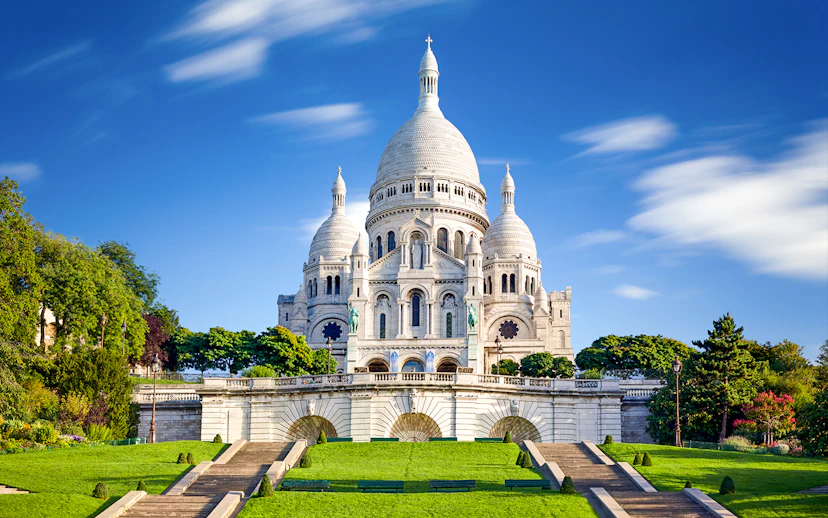
Explore Paris’s artistic hilltop neighborhood with a local guide and step inside its most famous basilica.
- Everything you get: Join a 90-minute guided walking tour through Montmartre’s charming streets, filled with cafés, street art, and historic landmarks like the Wall of Love, Moulin Rouge, Bateau-Lavoir, and La Maison Rose. The tour ends at Sacré-Cœur Basilica, and the entry to the church is free.
- Why choose this: Enjoy an affordable, hassle-free way to explore one of Paris’s most artistic districts with a local expert. Unlike a hike, this is a relaxed stroll, easy for all ages, giving you plenty of time to take in Montmartre’s top landmarks and hidden gems without feeling rushed or tired.
- Upgrade: Add basilica dome access for panoramic city views of Paris or a meal in a French restaurant.
Inclusions #
90-minute guided walking tour of Montmartre
Tickets to the dome of the Sacré-Cœur Basilica (as per option selected)
Audio guide available in English, Spanish and French (as per option selected)
Meal in French restaurant - Main course and dessert (as per option selected)
Exclusions #
- Guided tour of the interior of the Sacré-Cœur Basilica
What to bring
- Wear comfortable walking shoes, as the tour involves walking on cobblestone streets and uneven surfaces.
- Bring a valid photo ID to match the name on your booking if requested by the tour operator.
What’s not allowed
- Large bags, suitcases, and oversized luggage are not permitted during the walking tour or inside the Sacré-Cœur Basilica.
- Pets are not allowed, except for registered service animals.
- Alcohol, drugs, and any form of intoxication are strictly prohibited during the tour.
- Smoking is not permitted during the guided tour or inside the Basilica.
- Flash photography, tripods, and filming equipment are not allowed inside the Basilica.
- The basilica remains an active place of worship where many visitors come to pray each day. Visitors are requested to dress appropriately by choosing attire that is modest and suitable for a place of worship.
Accessibility
- This experience is not wheelchair accessible due to cobblestone streets, stairs, and uneven terrain throughout Montmartre and at the Sacré-Cœur Basilica.
Additional information
- Arrive at the meeting point at least 15 minutes before time, so your guide can check you in.
- Entry to Sacré-Cœur Basilica is free; access to the dome is ticketed.
- The only access to the dome is through a narrow 280-step staircase. Hence, the tour is not recommended for visitors with mobility issues or who have claustrophobia.
- Get full refund if you cancel 24 hours before the experience start time.

Explore a charming hilltop neighborhood with a guide and enjoy stunning Paris views from its famed basilica dome.
- Everything you get: Guided walking tour through Montmartre’s most iconic spots, including entry to the Sacré Coeur Dome, visits to the “Je t’aime” wall, Bateau Lavoir, Dalida’s residence, Moulin de la Galette, Le Passe-Muraille, Maison Rose, and Place du Tertre.
- Why choose this: Discover Montmartre like an insider with a local guide who shares hidden stories, secret spots, and cultural gems most visitors miss. This intimate, stress-free tour ends with rare access to the Sacré-Cœur Dome.
Inclusions #
90-minute walking tour of Montmartre
Expert guide
Access to the dome of Sacre Coeur Basilica
Exclusions #
- Access to the interior of the Sacre Coeur Basilica
What to bring
- Wear comfortable walking shoes, as Montmartre’s streets can be steep and cobbled.
- Carry a valid photo ID matching the name on your booking if requested at the meeting point.
What’s not allowed
- Large bags, suitcases, and oversized luggage are not permitted on the tour.
- Pets are not allowed, except for registered service animals.
- Alcohol, drugs, and any form of intoxication are strictly prohibited during the tour.
- Entry to private properties is not included and is not permitted during the tour.
Accessibility
- This experience is not wheelchair accessible due to steep, cobbled streets and multiple stairs and inclines along the route.
Additional information
- Late access will not be possible; if you are late, you cannot reschedule the tour.
- The tour involves moderate walking and several stairs and inclines; a reasonable level of fitness is required.
- Please respect private properties and local residents during the tour.
- Get full refund if you cancel 24 hours before the experience start time.

Experience Montmartre’s iconic masterpiece of Romano-Byzantine architecture with this multilingual guided tour.
- Everything you get: A guided tour of Sacré-Cœur Basilica and Montmartre, led by an expert guide. Uncover the basilica’s rich history, admire its world-famous mosaics, and stroll through Montmartre, one of Paris’s most enchanting neighborhoods.
- Why choose this: A visit to Montmartre isn’t complete without stepping inside this legendary church. With a knowledgeable guide by your side, uncover stories and insights that most visitors miss.
- Upgrades: Enhance your visit with dome access, a detailed map, and an audio guide for the ultimate Sacré-Cœur experience.
Inclusions #
Guided tour of Sacré-Cœur Basilica
Walk around the village of Montmartre
Guide available in English, French or Spanish
Sacré Coeur dome entry ticket (as per option selected)
Sacré Coeur interior and exterior audio guide (as per option selected)
Digital panoramic map (as per option selected)
Host at the meeting point (as per option selected)
Montmartre district English audio guide (as per option selected)
Exclusions #
Pick up from hotel
Food and drinks
Gratuities
What to bring
- Bring your own headphones and a mobile device if you wish to access the audio guide.
- Wear comfortable shoes, as the experience involves walking and, for dome access, climbing over 300 narrow steps.
- Carry a valid photo ID if requested at the entrance.
What’s not allowed
- Photography is not permitted inside Sacré Coeur; photos may only be taken from the dome and outside the building.
- Large bags, suitcases, and oversized luggage are not allowed inside for security reasons.
- Pets are not permitted, except for registered service animals.
- Food and drinks are not allowed inside the Basilica.
- Alcohol, drugs, and any form of intoxication are strictly prohibited on the premises.
Accessibility
- This experience is not recommended for people with limited mobility, heart or back problems, claustrophobia, or vertigo.
- The dome climb requires ascending over 300 narrow steps and is not wheelchair accessible.
Additional information
- Sacré Coeur is an active place of worship; opening hours may vary during special religious ceremonies, and visitors are asked to respect the silent prayer atmosphere.
- Get full refund if you cancel 24 hours before the experience start time.

Want to skip Montmartre's uphill walk? Board the Little Train for a fun and easy experience.
- Everything you get: Hop aboard the Montmartrain for a 30-minute ride through Montmartre’s cobbled streets, accompanied by classic French music. See iconic sites like the Sacré-Cœur Basilica, Moulin Rouge, St. Peter's Church, Montmartre Cemetery, and the cabaret 'Au Lapin Agile'.
- Why choose this: Effortlessly explore Montmartre’s highlights in comfort, soaking up panoramic Paris views and local culture on a fun, flexible mini train ride.
- Upgrades: Add a 1-hour Seine River cruise to your experience and glide past the Eiffel Tower, Louvre, and Notre-Dame with audio commentary in 14 languages.
Inclusions #
35-minute train ride to and from Montmartre
1-hour Seine River cruise (as per option selected)
Audio guide in 14 languages (as per option selected)
Exclusions #
- Audio guide for the train ride
What to bring
- Bring your mobile ticket or printed voucher to present to staff when boarding the Montmartre train and, if applicable, the Seine River cruise.
- Carry a valid photo ID for verification.
What’s not allowed
- Large bags, suitcases, and oversized luggage are not allowed on the train or cruise.
- Pets are not permitted, except for registered service animals.
- Alcohol, drugs, and any form of intoxication are strictly prohibited on the premises.
- Smoking is not allowed on the train or cruise.
Accessibility
- The train journey is not wheelchair accessible, but the cruise is.
Additional information
- The operating hours for Montmartre Train are from 10am–4.30pm; departures are every hour during weekdays and every 30 minutes during weekends.
- Boat departures vary every 30 minutes to 1 hour. Tickets are valid for a month after the travel date. During peak seasons, you may face longer waits (up to 1 hour) for the cruise due to the high number of visitors.
- Get full refund if you cancel 24 hours before the experience start time.

What to bring
- Bring a valid photo ID, especially if you wish to participate in the drinks package (must be 18 or older).
- Wear comfortable shoes, as the tour involves about 1 hour of walking.
- Have your booking confirmation ready on your phone for entry.
What’s not allowed
- Pets are not permitted on the tour.
- Strollers are not accommodated; infants must be carried.
- Additional alcoholic beverages beyond those included in your package are not allowed.
- Large luggage and suitcases are not recommended due to walking and space limitations.
Accessibility
- This experience is not wheelchair or scooter accessible.
- The tour route is not suitable for strollers.
Additional information
- Vegetarian-friendly tours are offered; however, options for vegan, gluten-free, or kosher diets may be limited. Inform about any dietary restrictions at the time of booking for optimal accommodation.
Inclusions #
3.5-hour Montmartre food tour
Small group of 12
Expert English-speaking guide
A glass of red and white wine
Authentic French cheeses, macarons, and artisanal chocolates
Fresh pastries and crêpes
Finest cured meats and freshly baked breads
A secret dish
Exclusions #
- Hotel pickup and drop-off
- Get full refund if you cancel 22 hours before the experience start time.
Which Montmartre ticket is best for you
| Ticket type | What's included | Best for | Price range |
|---|---|---|---|
Self-guided Montmartre visit | Free neighborhood access + free Sacré-Cœur interior entry + paid add-ons separately | A short Paris itinerary where you mainly want the hilltop view, village atmosphere, and the flexibility to stop whenever you like | Free |
Sacré-Cœur Dome Entry | Dome access only | A visit where the main goal is the panorama and you do not mind a narrow staircase with roughly 300 steps | From €8 |
Guided Montmartre walking tour | Local guide + walking route through Sacré-Cœur surroundings + Place du Tertre + historic lanes | A first visit where you want the artist history and hidden-route logic without figuring out the hill on your own | From €25 |
Musée de Montmartre entry ticket | Museum entry + permanent collection + Renoir Gardens | A slower art-focused visit where you want quieter time away from the basilica crowds and stronger historical context | From €16 |
Moulin Rouge show ticket | Reserved show seat + cabaret performance + champagne on standard packages | A same-day plan that starts with Montmartre by daylight and ends with its most famous nightlife experience | From €100 |
How do you get around Montmartre?
Getting around Montmartre
Maps and navigation tools
What is Montmartre worth visiting for?