Hours, directions, entrances and the best time to arrive
How to visit the Conciergerie in Paris
The Conciergerie is a former royal palace turned Revolutionary prison, best known for its vast Gothic halls and its link to Marie-Antoinette. It’s a compact visit, but not a light one — the route moves from grand medieval architecture into dense prison history, and the difference between a flat visit and a memorable one is usually the HistoPad. If you’re pairing it with Sainte-Chapelle, timing matters more than distance. This guide covers entry, timing, tickets, route, and what to prioritize once you’re inside.
Quick overview: the Conciergerie at a glance
If you want the short version before you book, this is the part that changes how the visit feels on the day.
- When to visit: Monday–Sunday, 9:30am–6pm. Right at opening is noticeably calmer than 11am–3pm, because combo-ticket visitors from Sainte-Chapelle and general Île de la Cité foot traffic build up later in the day.
- Getting in: From €13 for standard entry. Sainte-Chapelle + Conciergerie combo tickets start from €23. Booking ahead helps most in spring, summer, and on weekends, while quieter weekdays are more forgiving.
- How long to allow: 1–1.5 hours for most visitors. It stretches closer to 2 hours if you use the HistoPad properly or spend time in the Hall of Names and memorial spaces.
- What most people miss: The Hall of Names and the Women’s Courtyard make the prison story land far better than a quick stop at the Marie-Antoinette memorial alone.
- Is a guide worth it? Usually not for the monument alone, because the HistoPad does a lot of the heavy lifting, but a guide is worth paying for if you want the full Île de la Cité story tied together.
🎟️ Slots for Sainte-Chapelle + the Conciergerie can sell out a few days in advance during spring weekends and summer. Lock in your visit before the time you want is gone. See ticket options
Jump to what you need
🕒 Where and when to go
🗓️ How much time do you need?
Visit lengths, suggested routes and how to plan around your time
🎟️ Which ticket is right for you?
Compare all entry options, tours and special experiences
🗺️ Getting around
How the site is laid out and the route that makes most sense
🏰 What to see
Salle des Gens d’Armes, Royal Kitchens, Marie-Antoinette memorial
♿ Facilities and accessibility
Restrooms, lockers, accessibility details and family services
Where and when to go
How do you get to the Conciergerie?
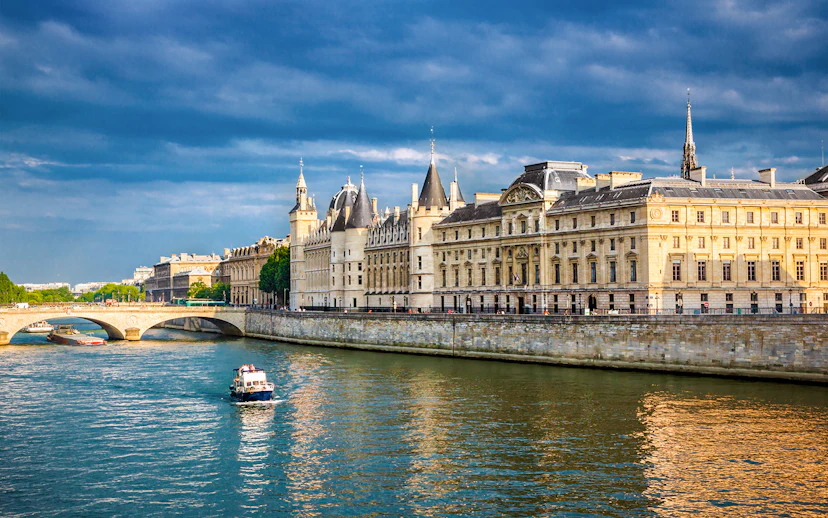
The Conciergerie sits on Île de la Cité in the historic heart of Paris, between Cité metro and Saint-Michel RER, and is easiest to reach on foot or by metro.
2 boulevard du Palais, 75001 Paris, France
- Metro: Cité (Line 4) → 3–5 min walk → the most direct stop for the boulevard du Palais entrance.
- RER: Saint-Michel–Notre-Dame (Lines B/C) → 8–10 min walk → cross toward Île de la Cité and follow signs for the Palais de Justice.
- Metro: Châtelet (Lines 1, 7, 11, 14) → 10–12 min walk → useful if you’re connecting from a major interchange.
- Bus: Lines 21, 24, 27, 38, 58, 81, 85, 96 → nearby stops → handy only if you’re already on route, because central traffic slows buses.
Which entrance should you use?
There is one public entrance, and the mistake most visitors make is assuming a prebooked ticket means skipping security. It doesn’t here — security checks still apply.
- Main entrance: Located at 2 boulevard du Palais. Best for all visitors. Expect roughly 10–30 min waits during 11am–3pm when security backs up and nearby sightseeing traffic peaks.
When is the Conciergerie open?
- Monday–Sunday: 9:30am–6pm
- Closed: May 1 and December 25
- Last entry: 5:30pm
- HistoPad pickup: Until 4:15pm
When is it busiest? Late morning through mid-afternoon, especially on weekends and in spring and summer, when Sainte-Chapelle visitors and central-island foot traffic overlap.
When should you actually go? Aim for the first hour after opening if you want the Gothic halls to feel spacious and the HistoPad reconstructions to be easier to use without crowding around screens.
Which Conciergerie ticket is best for you
| Ticket type | What's included | Best for | Price range |
|---|---|---|---|
Conciergerie entry ticket | Entry to the Conciergerie + self-guided visit + access to HistoPad features when available | A shorter history-focused visit where you want flexibility and don’t need Sainte-Chapelle on the same ticket | Entry (from €13) |
Sainte-Chapelle + Conciergerie combined ticket | Sainte-Chapelle entry + Conciergerie entry | A first visit to Île de la Cité where you want the strongest visual stop and the strongest historical stop in one plan | Combo (from €23) |
Guided Île de la Cité tour | Guide + historical context around the palace complex + monument routing that varies by product | A first visit where you want the medieval palace, prison, and nearby cathedral area explained as one story | €38.25 |
Paris Museum Pass | Pass access to the Conciergerie + entry to participating museums and monuments | A sightseeing-heavy Paris itinerary where the Conciergerie is one stop among several paid monuments | €85 for 2 days, €105 for 4 days, and €125 for 6 days |
How do you get around the Conciergerie?
The Conciergerie is best explored on foot, and most visitors can cover the full route in 1–1.5 hours without backtracking. The main Gothic spaces land early, while the more emotionally important Revolutionary sections come later, so don’t spend all your time in the first hall.
Inside the route
The Conciergerie is best explored on foot and is compact enough to cover in about 1–1.5 hours, but the route rewards a clear order more than people expect. The big architectural payoff comes early, while the most emotionally important prison spaces come later.
- Salle des Gens d’Armes: The vast Gothic medieval hall → the architectural high point of the visit → allow 15–20 min.
- Salle des Gardes: Former guardroom and transition space → useful for reading the palace layout before the prison story begins → allow 10 min.
- Royal Kitchens: The working heart of the old palace → best for understanding how the complex functioned beyond ceremony → allow 10–15 min.
- Women’s Courtyard and prison route: Revolutionary prison spaces → the mood shifts here from grand to grim → allow 15–20 min.
- Hall of Names and Marie-Antoinette memorial: The strongest historical and emotional section → worth slowing down for, especially if you’ve rushed the earlier rooms → allow 20–25 min.
Suggested route: Start with the medieval halls while your attention is fresh, then move steadily into the prison route, and save extra time for the Hall of Names and memorial spaces — that’s the section most visitors under-budget because the Gothic hall gets all the early attention.
Maps and navigation tools
- Map: HistoPad-based digital interpretation → covers reconstructions of the medieval palace and prison → collect it before 4:15pm on arrival.
- Signage: Good enough for the basic route, but the HistoPad adds the context that plain room labels can’t.
- Audio guide / app: The HistoPad is the key interpretation layer here → it adds far more value than a pure self-guided walk through otherwise sparse rooms.
💡 Pro tip: Pick up the HistoPad as soon as you enter — if you leave it too late, you’ll understand the architecture but miss what once made these rooms feel like a palace and prison.
What are the most significant spaces in the Conciergerie?

1/6
Salle des Gens d’Armes
Era: Early 14th century
This is the room that makes most first-time visitors stop walking. It’s the largest surviving Gothic civil hall in Europe, and its scale changes the way you read the rest of the monument — this was once a working royal palace, not just a prison. What many people miss is the surviving black marble table fragment on the wall, a small trace of the vanished ceremonial rooms above.
Where to find it: Near the start of the main visitor route, before the prison spaces.
Royal Kitchens
Era: Mid-14th century
The kitchens matter because they ground the palace in daily function rather than royal symbolism. They show how the site worked behind the scenes, with food and supplies once arriving from the Seine, and they break up the visit before the Revolutionary section darkens in tone. Most people pass through quickly without noticing how unusual it is to see this much of a royal service area survive.
Where to find it: Off the medieval section of the route, before the prison interpretation deepens.
Women’s Courtyard
Era: Revolutionary prison period
This is one of the most atmospheric parts of the visit because it still feels close to the prison the Revolution used. The official interpretation notes that it remains almost unchanged since that period, which gives it a weight the reconstructed rooms don’t always have. Many visitors rush through on the way to the Marie-Antoinette spaces and miss how much this courtyard explains ordinary prison life.
Where to find it: In the prison section, after the medieval halls and before the memorial spaces.
Hall of Names
Era: Revolutionary period memorial space
If you want the human scale of the Conciergerie, this is it. The Hall of Names lists more than 4,000 prisoners who passed before the Revolutionary Court, and it turns a famous history story into something much broader than just Marie-Antoinette. Many visitors glance at it and move on, but reading even a few entries changes the tone of the entire visit.
Where to find it: Toward the later prison route, close to the memorial section.
Marie-Antoinette memorial chapel
Era: 19th-century memorial on the site of the former cell
This is the emotional stop most people come looking for, and it delivers in a quieter way than the name suggests. The black walls, symbolic decoration, and commemorative tone mark a sharp shift from prison interpretation to remembrance. What visitors often miss is that this is not the original cell itself, but a later memorial created partly on its site.
Where to find it: Near the end of the prison and memorial route.
Marie-Antoinette memorial space
Era: 19th-century memorial on part of the former cell site
This is the most emotionally staged part of the visit, with black walls and silver tears creating a deliberate break from the rawer prison spaces around it. It matters less as a reconstructed prison room than as a memory site shaped by what later generations wanted this story to mean. Many visitors expect a literal preserved cell and don’t pause to read the memorial as its own historical layer.
Where to find it: Toward the end of the Revolutionary route, in the memorial area tied to Marie-Antoinette.
Facilities and accessibility
- 🎧 HistoPad: The monument’s main interpretation tool is available until 4:15pm and adds the AR and 3D reconstructions that make the visit much clearer.
- 🧒 Family treasure hunt: Families can use the HistoPad’s treasure-hunt mode, which gives children something more active to do than reading room panels.
- 🛂 Security screening: Entry includes X-ray screening, and small foldable strollers need to fit through the machine.
- 🎟️ Free-admission processing: Visitors in free-entry categories should bring proof, because age, residence, disability, or status checks happen on arrival.
- 🧾 On-site ticket validation: Prebooked tickets still need to be scanned at entry, so keep the QR code easy to reach before you get to the checkpoint.
- ♿ Mobility: Disabled visitors and one companion get free admission and priority access with proof, but the monument is not equipped as a fully step-free PRM route.
- 👁️ Visual impairments: The monument recognizes adapted visitor support categories, and the receptionist is the best first stop for available assistance on arrival.
- 🧠 Cognitive and sensory needs: The HistoPad helps by turning sparse rooms into clear visual reconstructions, and the quietest windows are usually right after opening.
- 👨👩👧 Families and strollers: Small foldable strollers are the safest option because security screening applies at entry and oversized pushchairs are harder to manage in a historic interior.
The Conciergerie works best for school-age children who like castles, prisons, or Revolution stories, and the HistoPad gives them something concrete to follow through the rooms.
- 🕐 Time: Around 1 hour is realistic with children if you focus on the big hall, kitchens, courtyard, and memorial section without lingering on every panel.
- 🏠 Facilities: The HistoPad is the family-friendly feature that matters most here, because it turns a quiet monument into a more interactive visit.
- 💡 Engagement: Use the treasure-hunt mode early, because once children have a task, the prison route feels more like discovery and less like a history lecture.
- 🎒 Logistics: Bring as little as possible, fold the stroller before security if needed, and aim for the first hour of the day when the halls feel easier to navigate.
- 📍 After your visit: The Seine-side walk toward Pont Neuf is the easiest decompression stop nearby if children need open space after the indoor route.
Rules and restrictions
What you need to know before you go
- Entry requirement: Timed or prebooked tickets are the safest option in busy periods, and free-entry categories need valid proof at the entrance.
- Bag policy: Bulky bags and luggage are not allowed, so don’t plan this as a stop between hotel checkout and a train.
- Visit flow: Treat the visit as one continuous loop, because security screening at entry makes stepping out mid-plan more trouble than it’s worth.
Not allowed
- 🚫 Large bags and luggage: Bulky bags are prohibited and are one of the easiest ways to get delayed at security.
- 🖐️ Sharp or hazardous items: Knives, scissors, aerosols, and similar items are not allowed through the checkpoint.
- 🍾 Glass bottles: Glass containers are prohibited, so carry a lighter day bag instead of a full picnic setup.
- 🛹 Wheeled leisure items: Scooters, skateboards, rollerblades, and motorbike helmets are not allowed inside.
Photography
Photography is best treated as something to confirm at the entrance on the day, especially if you want to use flash, tripods, or selfie sticks. The route includes memorial and interpretive spaces as well as temporary displays, so rules can be more restrictive than in a standard museum gallery. If taking photos matters to you, ask before you begin instead of assuming the same policy applies everywhere inside.
Good to know
- HistoPad cutoff: The monument stays open until 6pm, but HistoPad tablets are available only until 4:15pm, which changes the quality of a late visit.
- Combo planning: If you’re visiting Sainte-Chapelle too, let that timed slot drive the day and fit the Conciergerie before or after it.
Practical tips
- Booking and arrival: Book ahead for weekends, spring, and summer, and arrive at least 15–20 minutes early because security checks still apply even with a prebooked ticket.
- Pacing: Don’t spend your entire visit in the Salle des Gens d’Armes — save 20–30 minutes for the prison route, because that’s where the monument’s story actually sharpens.
- Crowd management: The best slot is usually right after opening, because you get the big Gothic hall with more breathing room before combo visitors and island foot traffic build.
- What to bring or leave behind: Bring a small day bag only; bulky luggage, helmets, glass bottles, and wheeled items can stop you at security before you even reach the ticket scan.
- Interpretation: If the HistoPad matters to you, don’t arrive after 4:15pm, because the monument loses much of its before-and-after impact without the reconstructions.
- Food and drink: Eat before you enter or plan to head toward Saint-Michel after the visit, because the Conciergerie works better as a compact indoor history stop than a long dwell site.
- Combo timing: If you have a Sainte-Chapelle reservation, anchor the day around that first — it’s the stricter timed visit, while the Conciergerie is the more flexible half of the pairing.
What else is worth visiting nearby?
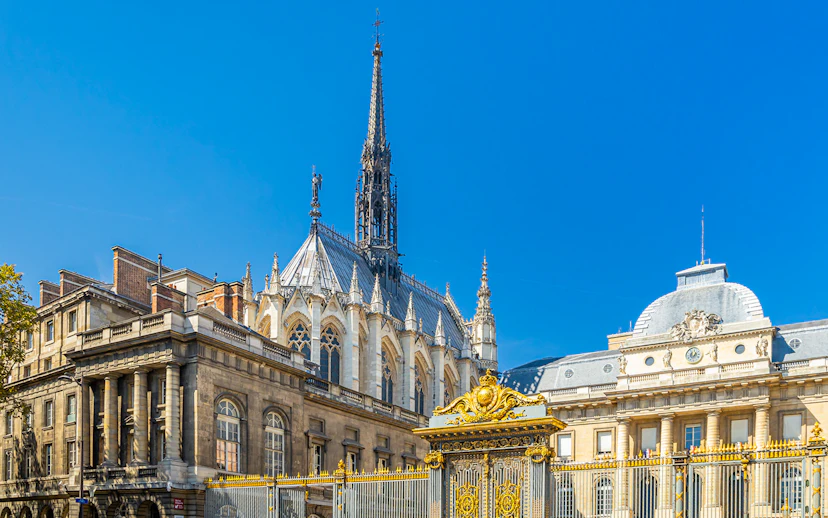
Commonly paired: Sainte-Chapelle
Distance: About 1–3 min walk
Why people combine them: They were part of the same Palais de la Cité complex, so the pairing gives you the strongest mix of visual impact and historical context on the island.
✨ Combo option: The Conciergerie and Sainte-Chapelle are most commonly visited together — and simplest to do on one combined ticket. It saves you from managing separate booking logic for the Conciergerie and gives you the clearest same-day palace route. → See combo options
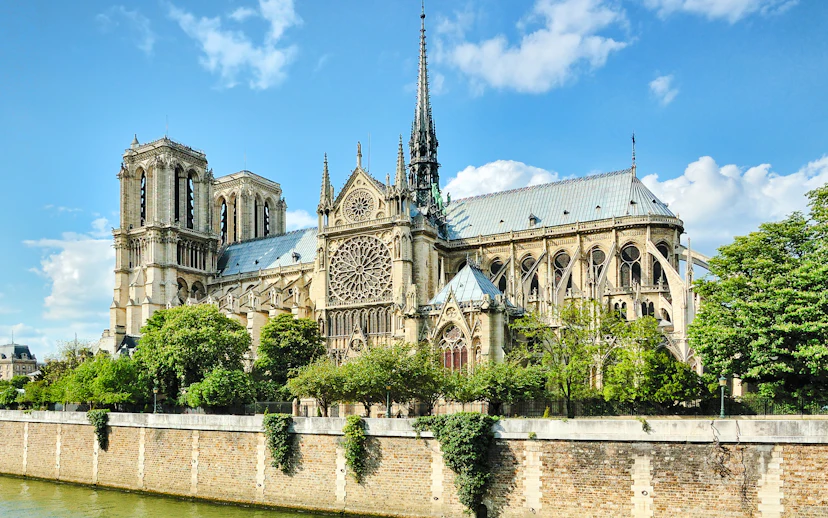
Commonly paired: Notre-Dame Cathedral
Distance: About 5–8 min walk
Why people combine them: It completes the medieval Île de la Cité story, moving from royal power and Revolutionary justice to Paris’s best-known cathedral setting.
Also nearby
Archaeological Crypt of Île de la Cité
Distance: About 5–8 min walk
Worth knowing: It adds Roman and early medieval layers under the cathedral square, which makes a strong follow-on stop if you want deeper historical context.
Pont Neuf and the Seine banks
Distance: About 5 min walk
Worth knowing: This is the easiest low-effort add-on after the prison route if you want open air, river views, and a mental reset without another ticketed stop.
Eat, shop and stay near the Conciergerie
- On-site: Plan as if there is no real meal stop inside, because this works best as a compact monument visit rather than a long food break.
- Saint-Michel cafés: 8-min walk, around Place Saint-Michel; best for coffee, pastries, or a fast breakfast before a 9:30am entry.
- Latin Quarter bistros: 10-min walk, around Rue de la Harpe; better for a sit-down lunch once you’re done with the island’s denser foot traffic.
- Châtelet dining streets: 12-min walk, around the Les Halles side; a smarter move if you want more variety and less time spent choosing between tourist menus right outside the monument.
- 💡 Pro tip: Eat before Sainte-Chapelle and the Conciergerie if you’re doing both together — once the timed slot starts shaping your route, meal timing becomes the easiest thing to misjudge.
- Île de la Cité souvenir kiosks: Best for quick postcards and small Paris keepsakes if you want something easy on the way out.
- Saint-Michel bookshops and gift stores: A better choice if you want history books, Paris prints, or a less rushed browse after the visit.
The Conciergerie is in one of the most central and walkable parts of Paris, so it’s convenient, but not always the smartest base for every budget. You’re close to major sights and easy transit, but hotel prices around Île de la Cité and nearby riverfront blocks tend to run higher than equally well-connected areas. It suits short stays where being able to walk to several headline sights matters more than getting the best room value.
- Price point: This area leans expensive, especially for river-adjacent hotels and short-notice bookings.
- Best for: Visitors on a short Paris trip who want to walk to Île de la Cité, Notre-Dame, Sainte-Chapelle, and central Left Bank sights.
- Consider instead: Saint-Michel and the Latin Quarter give you similar walkability with more food options, while Châtelet works better if you want stronger metro connections and more choice at different price points.
Frequently asked questions about visiting the Conciergerie
Most visits take 1–1.5 hours. You’ll need closer to 2 hours if you use the HistoPad properly, visit with children, or spend time in the Hall of Names instead of rushing straight to the Marie-Antoinette memorial spaces.
Yes, booking in advance is the safer move, especially on weekends, in spring, and in summer. It won’t remove security checks, but it does cut out ticket-buying friction and makes it easier to pair the visit with a Sainte-Chapelle reservation.
Yes, if by ‘skip the line’ you mean avoiding the ticket-purchase queue rather than skipping security. Security screening still applies to everyone, so the real advantage is smoother entry, not walking straight inside.
Arrive 15–20 minutes early. That gives you enough time for security screening without turning a compact 1-hour visit into a rushed one, especially if you’re fitting the Conciergerie around another timed stop nearby.
Yes, a small day bag is usually the right fit, but bulky luggage and oversized bags are not allowed. Sharp objects, glass bottles, scooters, skateboards, rollerblades, and similar items are also prohibited at security.
Photography is usually easiest if you treat it as something to confirm at the entrance on the day. If flash, tripods, or selfie sticks matter to you, ask before you start because rules can be stricter in memorial or temporary-display areas.
Yes, but groups should plan ahead. The monument is compact, and even though the route is straightforward, security screening and timed planning around nearby sights can slow down large groups more than people expect.
Yes, especially for school-age children. The HistoPad and its treasure-hunt mode make a big difference, because without that layer the prison history can feel heavy and the rooms can feel sparse to younger kids.
No, it should not be described as fully wheelchair accessible. Disabled visitors and one companion can receive free admission and priority access with proof, but the monument is also officially described as not equipped with full PRM access.
Yes, nearby rather than inside is the better assumption. Saint-Michel, the Latin Quarter, and Châtelet all give you more practical meal options within about 8–12 minutes on foot.
Yes, the HistoPad is presented as a core part of the visit experience, but availability matters. Tablets are distributed only until 4:15pm, so late arrivals can miss the interpretation layer that makes the rooms much easier to understand.
The combo is the smarter choice for most first-time visitors. Standalone entry works better if you’ve already seen Sainte-Chapelle or if you’re coming mainly for the Revolutionary prison story and want a shorter, quieter visit.