Hours, directions, entrances and the best time to arrive
Choco-Story Paris visitor guide and tips
Choco-Story Paris is a compact chocolate museum best known for combining 4,000 years of cacao history with tastings, live chocolatier demos, and optional hands-on workshops. The visit is easy to do in under 90 minutes, but it feels fuller than its size because the exhibits, tasting stops, and demo area are spread across three floors. The biggest difference between a rushed visit and a good one is timing the live demonstration well. This guide covers when to go, how long to plan for, tickets, and what not to miss.
Quick overview: Choco-Story Paris at a glance
If you want a fun indoor Paris attraction that works for adults and kids, this one is easiest when you treat it as a short, well-timed visit rather than a half-day museum.
- When to visit: Daily 10am–6pm. Weekday mornings, especially 10am–11:30am, are noticeably calmer than rainy weekend afternoons, and you’ll have a better view of the demo space before families and last-minute visitors pile in.
- Getting in: From €15 for standard entry. Chocolate workshop tickets from €50. You can usually show up for general admission, but workshop slots and holiday visits are better booked ahead.
- How long to allow: 1–1.5 hours for most visitors. It stretches to 2.5–3 hours if you add the workshop and linger at the tasting stations.
- What most people miss: The live chocolatier demo, the flavor-guessing praline game, and the historical context on the first galleries that makes the tastings feel less random.
- Is a guide worth it? Usually no for the museum alone, because the route is straightforward and the panels are multilingual, but the workshop adds real value if you want something more hands-on than self-guided browsing.
🎟️ Workshop slots for Choco-Story Paris can fill 2–5 days in advance during French school holidays and rainy weekends. Lock in your visit before the time you want is gone. See ticket options
Jump to what you need
🕒 Where and when to go
🗓️ How much time do you need?
Visit lengths, suggested routes and how to plan around your time
🎟️ Which ticket is right for you?
Compare all entry options, tours and special experiences
🗺️ Getting around
How the galleries are laid out and the route that makes most sense
🍫 What to see
Chocolate Eiffel Tower, live demo, and tasting stations
♿ Facilities and accessibility
Restrooms, lockers, accessibility details and family services
Where and when to go
How do you get to Choco-Story Paris?
Choco-Story Paris is in the Grands Boulevards area, just off Bonne Nouvelle station and about 2km from the Louvre side of central Paris.
28 Boulevard de Bonne Nouvelle, 75010 Paris, France
→ Open in Google Maps (Google Maps: ‘Choco-Story Paris’)
- Metro: Bonne Nouvelle (Lines 8, 9) → 1-min walk → Exit onto Boulevard de Bonne Nouvelle.
- Bus: Lines 20, 39, 48 → stop near Bonne Nouvelle → short walk along the boulevard.
- Taxi / rideshare: Drop-off at 28 Boulevard de Bonne Nouvelle → easiest for families or workshop arrivals.
Full getting there guide
Which entrance should you use?
There’s one main street entrance, and the usual mistake is overthinking it as if it were a large Paris museum. It isn’t — just head to the front desk with your mobile or printed ticket.
- Located on Boulevard de Bonne Nouvelle. Expect 0–10 min wait during rainy weekend afternoons and French school holidays.
Full entrances guide
When is Choco-Story Paris open?
- Monday–Sunday: 10am–6pm
- December 25: Closed
- Last entry: 5pm
When is it busiest? Rainy weekend afternoons, school holidays, and the second half of December are the busiest, when the demo room feels fuller and tasting stations attract clusters of families.
When should you actually go? Weekday mornings outside French school breaks are the easiest window because the galleries are quieter, the demo area is easier to see, and you can move between tasting stops without crowding.
How much time do you need?
| Visit type | Route | Duration | Walking distance | What you get |
|---|---|---|---|---|
Highlights only | Entrance → ancient cacao gallery → tasting stops → chocolate Eiffel Tower → exit | 45–60 min | ~0.4km | You’ll get the core story, a few tastings, and the best photo stop, but you may miss the demo timing and rush the European history section. |
Balanced visit | Entrance → ancient cacao gallery → European machinery floor → live demo → tasting stations → sculptures → exit shop | 1–1.5 hr | ~0.7km | This is the best fit for most visitors because you get the full museum, the tastings, and the demo without dragging the visit out. |
Full exploration | Full museum route → live demo → workshop check-in → chocolate-making class → gift shop / café | 2.5–3 hr | ~1km | This adds the hands-on workshop and take-home chocolates, but it only makes sense if you book a timed workshop ticket and actually want to spend extra time making rather than just tasting. |
Which Choco-Story Paris ticket is best for you
| Ticket type | What's included | Best for | Price range |
|---|---|---|---|
Standard museum entry | Museum entry + self-guided exhibits + chocolatier demo + tastings | A short indoor Paris activity where you want something easy, flexible, and low-commitment | From €15 |
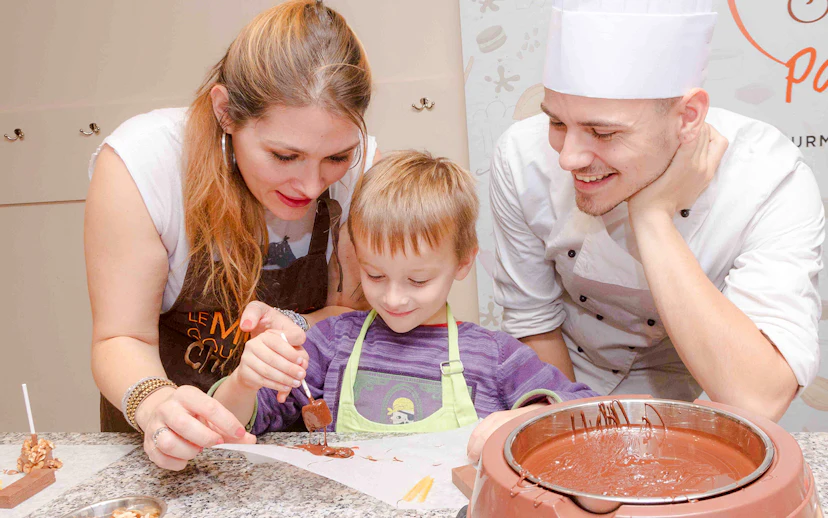
Museum entry + chocolate workshop | Museum entry + 45-min chocolatier-led workshop + take-home chocolates | A visit where watching isn’t enough and you want a timed, hands-on activity that gives kids or adults something concrete to do | From €50 |
Museum entry + hot chocolate | Museum entry + exhibits + tastings + café hot chocolate | A quick museum visit where you want the chocolate history and one extra themed treat without committing to the workshop | From €20 |
Seasonal themed workshop | Museum entry + holiday workshop + take-home creations | A return visit or family trip where the standard museum route feels too short and you want a more event-like experience | From €50 |
How do you get around Choco-Story Paris?
Museum layout
Choco-Story Paris is a compact, multi-floor museum with a mostly chronological layout, so it’s easy to self-navigate as long as you follow the floors in order rather than hopping straight to the tasting points.
- Ground floor → ancient cacao origins, Mayan and Aztec objects, and the early story of chocolate → 20–30 min.
- First floor → European chocolate history, antique machinery, and the live demo area → 20–30 min.
- Upper floor → modern displays, chocolate sculptures, kids’ interactives, and workshop-related spaces → 15–20 min.
Suggested route: Start at the beginning and save the tasting stations for between sections rather than treating them as the main event; most visitors rush toward the sweets and then skim the first galleries that make the rest of the museum more interesting.
Maps and navigation tools
- Map: Simple on-site floor plan → covers the three exhibit levels and main stops → pick it up or check orientation at the front desk.
- Signage: Wayfinding is good enough for most visitors, and this is not a museum where you need a downloaded map in advance.
- Audio guide / app: There isn’t a full audioguide, but labels are available in French, English, and Spanish, so self-guided works well unless you want more context from the live demo or workshop.
💡 Pro tip: Don’t rush upstairs the moment you enter unless a demo is about to start — the chronology makes much more sense if you begin with cacao origins and build toward the machinery and tasting sections.
Get the Choco-Story Paris map / audio guide
Where are the masterpieces inside Choco-Story Paris?

1/6
The origin of chocolate exhibit
Attribute — Era: Pre-Columbian to early colonial cacao history
This is where the museum earns its place as more than a tasting stop. You’ll see how cacao was used in ritual life, trade, and daily culture long before it became a Parisian luxury. What many visitors rush past is how much of the modern chocolate story starts here, not in Europe.
Where to find it: Ground floor, in the opening galleries immediately after the entrance.
European chocolate history and machinery
Attribute — Era: 16th–20th century chocolate making
This section follows chocolate from elite European drink to industrial-era product, with antique serving ware and early machines that explain how production changed. It’s worth slowing down for the machinery, because it turns a museum full of pretty objects into a practical story. Many visitors skim the packaging and court history displays, which are more revealing than they first look.
Where to find it: First floor, after the early-history galleries and before the demonstration area.
Live chocolatier demonstration
Attribute — Creator: In-house chocolatier team
The demonstration is one of the most rewarding parts of the visit because it breaks up the reading-heavy galleries with something visual, practical, and immediate. You get to watch real technique rather than just read about production. What people miss is that arriving a few minutes late can leave you stuck at the back with a poor view.
Where to find it: First floor, in the demonstration center beside the machinery displays.
Unlimited praline tasting game
Attribute — Experience type: Interactive tasting
The tasting stations keep the museum fun, especially if you’re visiting with children or anyone who loses patience in text-heavy galleries. The flavor-guessing element makes the samples feel like part of the visit instead of a side perk. Many visitors use up their appetite early and don’t enjoy the later tastings as much.
Where to find it: Spread throughout the museum route, especially between major exhibit sections.
Chocolate Eiffel Tower
Attribute — Medium: Chocolate sculpture
This 3-meter chocolate Eiffel Tower is the museum’s easiest Paris-only photo stop and a good reminder that chocolate here is treated as craft as much as food. It’s worth pausing for the detail work rather than just snapping one photo and moving on. What visitors often miss is that the barriers and lighting make flash more annoying than helpful.
Where to find it: Upper-level display area near the museum’s sculpture section.
Hands-on chocolate workshop
Attribute — Experience type: Chocolatier-led workshop
If you’ve booked the workshop, this is the part of the visit that turns you from observer into participant. You’ll make your own chocolates, decorate them, and take them home. What many people underestimate is the timing — it works best when you build the rest of your visit around the workshop slot, not the other way around.
Where to find it: Dedicated workshop room within the museum, accessed at your booked session time.
Facilities and accessibility
- 🍽️ Café: The small on-site café serves traditional hot chocolate for around €3 and works best as a post-visit treat rather than a full meal stop.
- 🛍️ Gift shop / merchandise: The exit shop sells artisan chocolate and take-home souvenirs, which is more practical than carrying extra purchases through the galleries.
- 🚻 Restrooms: Restrooms are available on-site, and it’s easiest to use them before a demo or workshop so you don’t leave mid-session.
- 🪑 Seating / rest areas: Seating is limited, especially near the demonstration space, so expect to stand during the chocolatier presentation.
- ♿ Mobility: The museum’s three floors are connected by elevator, making the main route workable for wheelchair users, though busy periods can make small exhibit areas feel tighter.
- 👁️ Visual impairments: There is no full audioguide, so visitors who prefer spoken interpretation may get more value from the live demo or by visiting with a companion.
- 🧠 Cognitive and sensory needs: This is usually a manageable museum for sensory-sensitive visitors, but the demo room and tasting stations are the loudest areas once families arrive.
- 👨👩👧 Families and strollers: Strollers are allowed, and the route is generally stroller-friendly, though narrow spots feel easier in the morning than on rainy afternoons.
Choco-Story Paris works best for children old enough to enjoy tasting, simple history, and a short indoor museum without needing long breaks.
- 🕐 Time: About 1 hour is realistic with younger children, and the tastings, sculpture area, and live demo are usually the easiest parts to prioritize.
- 🏠 Facilities: The workshop is the main family-focused extra, giving children a structured activity rather than asking them to stay engaged with panels alone.
- 💡 Engagement: Turn the tasting stations into a guessing game, because children tend to stay focused longer when they’re trying to identify flavors instead of just snacking.
- 🎒 Logistics: Bring a small bag and arrive earlier in the day, since bulky gear, crowds, and sugar all become harder to manage once the museum gets busier.
- 📍 After your visit: Musée Grévin is a short walk away and is an easy follow-up if your child still has energy for another indoor attraction.
Rules and restrictions
What you need to know before you go
- Standard museum tickets are flexible, but workshop tickets are tied to a specific session time and reduced-rate tickets may require ID or proof of eligibility.
- Small day bags are easiest here, because the museum is compact and three floors of displays, stairs, and tasting stops are less comfortable with bulky luggage.
- Plan to do the museum in one pass, because it’s a short visit and leaving midway usually breaks the timing of the demo or workshop more than it helps.
Not allowed
- 🚫 Outside food and drink are best saved for before or after the visit so the museum tastings remain the main food element inside.
- 🚬 Smoking and vaping are not allowed inside the museum.
- 🐾 Pets should be left at home unless you are traveling with a service animal.
- 🖐️ Don’t touch the chocolate sculptures or historic objects, because they are display pieces rather than hands-on exhibits.
Photography
Photography is generally fine for personal use, and the chocolate Eiffel Tower is one of the easiest places to stop for photos. Keep flash off around reflective cases and chocolate sculptures, and expect tripods or selfie sticks to be a poor fit in the museum’s compact rooms. If a workshop or temporary display is signed differently, follow the posted rule there.
Good to know
- The demo room fills faster than the rest of the museum, so arriving a few minutes early matters more than racing through the galleries.
- Tasting stations are spread along the route, not saved for the end, so pace yourself if you’re visiting with children.
Practical tips
- Book the workshop a few days ahead if you’re visiting during French school holidays, on a rainy weekend, or in late December, because the museum itself stays flexible but workshop capacity does not.
- Arrive 10–15 minutes early for a timed workshop, since the class starts on schedule even though general museum entry is more relaxed.
- Save your attention for the live demo and machinery floor, because that’s where the museum becomes more than a sequence of panels and tasting dispensers.
- Weekday mornings work especially well here because the museum feels calmer, the demo room is easier to see, and children aren’t yet clustering around every tasting stop.
- Bring a small bag rather than a large backpack, since the rooms are compact and you’ll be more comfortable moving between tastings, photo stops, and the workshop space.
- Eat a real lunch before or after your visit, not during it — the tastings are fun, but they’re not substantial, and the on-site hot chocolate makes more sense as dessert than a meal.
What else is worth visiting nearby?
Commonly paired: Musée Grévin
Musée Grévin
Distance: 400m — 5-min walk
Why people combine them: Both work well as compact indoor attractions on the Grands Boulevards, and together they make a strong rainy-afternoon plan without heavy transit.
Book / Learn more
Commonly paired: Le Grand Rex Studios Tour
Le Grand Rex Studios Tour
Distance: 160m — 2-min walk
Why people combine them: It’s an easy same-neighborhood pairing if you want one playful, visual attraction before or after the museum without crossing the city.
Book / Learn more
Also nearby
Passage Jouffroy
Distance: 500m — 7-min walk
Worth knowing: This historic covered passage adds old-Paris atmosphere, small shops, and an easy wandering stop if you want to extend the outing without booking another attraction.
Passage des Panoramas
Distance: 450m — 6-min walk
Worth knowing: It’s a good place to continue the food-and-shopping mood after the museum, especially if you want a short stroll before lunch or dinner.
Eat, shop and stay near Choco-Story Paris
- On-site: Choco-Story café, hot chocolate and sweet drinks, around €3 for a cup, worth it as a themed extra but not as a lunch substitute.
- Le Brebant (6-min walk, 32 Boulevard Poissonnière): Classic brasserie fare, mid-range prices, and a convenient option if you want a proper sit-down meal close to the museum.
- Bouillon Chartier (9-min walk, 7 Rue du Faubourg Montmartre): Traditional French food at budget-friendly prices, useful if you want a filling meal before or after a shorter museum visit.
- Mamiche (11-min walk, 45 Rue du Faubourg Poissonnière): Bakery and coffee spot, good for a lighter pre-visit pastry if you don’t want to arrive already over-sugared.
- Pro tip: Eat something savory before you go, because the tastings land better as dessert than as a stand-in for lunch.
- Choco-Story gift shop: Chocolate bars, cocoa-themed souvenirs, and easy take-home gifts, located at the museum exit.
- Passage Jouffroy: Small shops and old-Paris arcade browsing, useful if you want to keep the sweets-and-souvenirs mood going after the museum.
- Galeries Lafayette Le Gourmet: Premium Paris chocolate brands under one roof, worth the short metro ride or 15-minute walk if you want a more serious chocolate shopping stop.
Bonne Nouvelle and the wider Grands Boulevards area make a practical short-stay base if you want strong transit, lots of cafés, and easy access to compact indoor attractions. It’s convenient rather than romantic, and it suits travelers who care more about moving around Paris efficiently than sleeping in the prettiest neighborhood.
- Price point: Mid-range overall, with some good-value business-style hotels and pricier options closer to Opéra.
- Best for: Short Paris trips where you want quick metro access and plenty of nearby food without spending time commuting back to the center.
- Consider instead: The Marais for a more atmospheric neighborhood stay, or Opéra / Saint-Lazare if you want stronger shopping access and slightly easier links to the wider city.
Frequently asked questions about visiting Choco-Story Paris
Most visits take 1–1.5 hours. If you read every panel, linger at the tasting stations, and watch the live chocolatier demo, you may stretch closer to 2 hours. If you’ve booked the workshop, plan on roughly 2.5–3 hours total for the museum and class together.
No, you usually don’t need to book standard entry far in advance. Choco-Story Paris is often a last-minute visit, and general admission is usually easy to get on the day. The exception is the chocolate workshop, which has limited timed slots and is worth reserving ahead during school vacations, weekends, and rainy weather.
Usually no, because entry lines here are short. Online booking is still useful, especially if you want to walk in quickly with a mobile ticket, but this isn’t a museum where Skip the line access changes the day the way it does at larger Paris landmarks. Workshop timing matters more than queue-skipping.
Arrive about 10–15 minutes early if you’ve booked a workshop. Standard museum tickets are flexible enough that you don’t need a big buffer, but a timed workshop starts on schedule and late arrivals can miss instructions or shorten the hands-on part. For general entry, arriving early mostly helps with crowd levels, not check-in.
Yes, a normal day bag or backpack is fine, but smaller is easier. The museum is compact, spread across three floors, and includes tasting stops, so bulky luggage quickly becomes awkward. If you’re visiting with children or planning to join the workshop, traveling light makes the whole route more comfortable.
Yes, photos are generally allowed for personal use. The chocolate Eiffel Tower and sculpture displays are especially photo-friendly. Keep flash off, since it reflects badly on display cases and barriers, and be considerate in the demo room where space is limited. If a temporary exhibit or workshop area posts separate rules, follow those signs.
Yes, groups can visit, and larger groups can access discounted rates. School visits and private groups are common here because the subject works well for mixed ages. If you’re organizing for 15 or more people, book ahead rather than turning up unannounced, especially if you want the workshop or a smoother timed entry.
Yes, it’s one of the better short indoor museum visits in Paris for families. The tastings, chocolate sculptures, flavor-guessing game, and workshop give children more to do than just read panels. It’s best for kids old enough to enjoy a 1-hour museum route, with the workshop especially popular from about 6 years and up.
Yes, the museum is wheelchair accessible. The three floors are connected by elevator, which makes the main route workable for most visitors with mobility needs. The biggest limitation is crowding rather than layout, since smaller display areas can feel tighter on rainy weekends and school-holiday afternoons.
Yes, there’s a small on-site café and plenty of nearby dining. Inside, the main extra is hot chocolate rather than full meals, so most visitors eat properly before or after the museum. Around Bonne Nouvelle and Grands Boulevards, you’ll find brasseries, bakeries, and casual cafés within 5–10 minutes on foot.
Yes, if the workshop is the main reason you’re going, book it ahead. Standard museum entry is flexible, but workshop spaces are limited to small groups and are the first thing to fill on busy dates. Booking a few days ahead is usually enough, though holiday periods and weekends can need more notice.
The museum is well set up for international visitors, with information available in French, English, and Spanish. That makes self-guided visiting much easier than in some smaller Paris attractions. If you want more spoken explanation, time your visit around the live demo or choose the workshop for a more guided feel.