Plan your visit to Atelier des Lumières
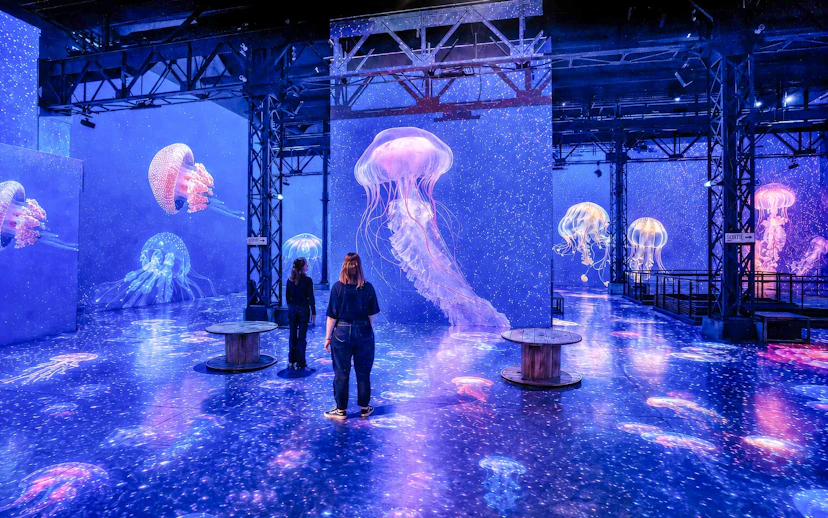
Atelier des Lumières is a fully digital art venue in Paris best known for wrapping a former 19th-century foundry in floor-to-ceiling projections and sound. The visit feels more like stepping into a moving image world than touring a museum, and the dark, open layout rewards people who are happy to wander, pause, and watch a full loop. The biggest mistake is leaving too early or moving upstairs too soon. This guide covers timing, entry, route, and what to prioritize.
Quick overview: Atelier des Lumières at a glance
If you want the visit to feel calm rather than chaotic, timing matters more here than distance.
- When to visit: Tuesday and Wednesday morning slots from 10:30am are noticeably calmer than weekend afternoons after 1pm, because family traffic and rainy-day demand fill the center of the hall fast.
- Getting in: From €19.50 for standard entry. Open tickets start around €22, and booking at least 48 hours ahead matters on weekends, school holidays, and gray-weather afternoons more than on weekday mornings.
- How long to allow: 1–1.5 hours works for most visitors, but stay closer to 2 hours if you want one full main loop plus the Studio, Cistern, Mirror Tower, and children’s area.
- What most people miss: The Cistern is the quietest part of the visit and explains the imagery best, while the mezzanine completely changes how you see the projections on the pillars and floor.
- Is a guide worth it? Usually no, because the venue is built for self-guided wandering, and an optional audio guide adds more value than following a fixed group route.
🎟️ Tickets for Atelier des Lumières often sell out 48 hours in advance during spring weekends, school holidays, and rainy spells. Lock in your visit before the time you want is gone. → See ticket options
Jump to what you need
🕒 Where and when to go
🗓️ How much time do you need?
🎟️ Which ticket is right for you?
🗺️ Getting around
✨ What happens inside
♿ Facilities and accessibility
Where and when to go
How do you get to Atelier des Lumières?
Atelier des Lumières is in Paris’s 11th arrondissement, between Bastille, Oberkampf, and Nation, around 2.5km east of the city center.
38 Rue Saint-Maur, 75011 Paris, France
- Walk: From Le Marais → 15–20 mins → the easiest option if you are pairing it with an east-side Paris afternoon.
- Metro: From Gare de Lyon → about 15–20 mins total via 1 change → best for rail arrivals who want a direct cross-city route.
- Metro: From Châtelet → about 20 mins total via 1 change → the simplest option if you are coming from central sightseeing stops.
- Taxi / rideshare: Drop-off at 38 Rue Saint-Maur → allow a few extra minutes if street works on Rue Saint-Maur are active.
Which entrance should you use?
There is one public entrance, but the left-hand side moves faster for people who already booked. The mistake most visitors make is joining the purchase line when they already have a timed ticket.
- Pre-booked tickets: Left-hand lane. Best for timed-entry visitors. Expect 5–15 mins during rainy afternoons, weekends, and school holidays.
- On-the-day purchases: Ticket-desk line. Best only if slots are still available. Expect longer waits and possible sellouts after 1pm on busy days.
When is Atelier des Lumières open?
The venue works on timed-entry sessions rather than one long free-flow day, so your exact options depend on the current show.
- Monday, Tuesday, Thursday, Saturday: Timed-entry sessions for the current main program, including morning entries from 10:30am.
- Wednesday, Friday, Sunday: Timed-entry sessions continue through the day, often with stronger family demand.
- Select evenings: Later slots appear for popular runs, and evening entry can be one of the best choices for adults.
- Last entry: The final admission depends on the day’s last bookable slot.
When is it busiest? Weekend afternoons after 1pm, French school holidays, and rainy spring or fall days are the crunch points, because the central floor fills first and security slows down.
When should you actually go? A weekday morning slot is the easiest win here, because you get more floor space in the main hall and less competition for cubes, mezzanine views, and the Mirror Tower.
How much time do you need?
| Visit type | Route | Duration | Walking distance | What you get |
|---|---|---|---|---|
Highlights only | Entry airlock → main hall center spot → one full long program → exit
| 45–60 mins | ~0.3km | You get the core immersive show, but you will mostly skip the Studio, Cistern, mezzanine, and any family-interactive add-ons.
|
Balanced visit | Main hall full loop → mezzanine and Mirror Tower → Studio → Cistern → exit
| 75–90 mins | ~0.6km | This adds the best alternate viewpoints and the quietest context room, which is what turns the visit from a spectacle into a more rounded experience.
|
Full exploration | Main hall full loop → mezzanine → Mirror Tower → Studio short program → children’s atelier if relevant → Cistern → second pass through the hall
| 90–120 mins | ~0.9km | This is the full venue at an unhurried pace, but the limited seating and dark environment start to wear on you if you linger without purpose.
|
Which Atelier des Lumières ticket is best for you
| Ticket type | What's included | Best for | Price range |
|---|---|---|---|
Standard timed entry
| Timed entry + access to the main hall + Studio + Cistern + Mirror Tower + children’s area when included with the current program
| You know when you want to go and want the full venue without paying extra for flexibility.
| From €19.50 |
Open ticket
| One-time entry within 30 days + same venue access as timed entry
| Your Paris plans are still shifting and you would rather pay a little more than risk a sold-out day.
| From €22 |
Family offer
| Entry for 2 adults + 2 youth ages 3–25 + same venue access
| You are traveling as a family of 4 and want the simplest way to save versus 4 separate tickets.
| From €52 |
Friends rate
| Discounted group entry for 4–10 people + same venue access
| You are coordinating one visit for a small group and want one shared slot without splitting bookings.
| From €17.80 |
Combo: Atelier des Lumières + Seine cruise / aquarium
| Timed entry + second Paris attraction | You have limited time and want one high-impact indoor visit bundled with another easy same-day plan.
| From €42 |
How do you get around Atelier des Lumières?
Layout and route
The layout is open and zone-based rather than linear, with one huge central hall supported by smaller side spaces and an upstairs vantage point. That makes it easy to self-navigate, but also easy to miss the quieter rooms if you stay glued to the floor show.
- La Halle → the main immersive projection space with the full long program → budget 35–50 mins.
- Mezzanine and Mirror Tower → upper-level views and the kaleidoscopic mirror room → budget 10–15 mins.
- Le Studio → shorter digital works and, depending on the season, the family-interactive area → budget 15–20 mins.
- La Citerne → quieter, more static projections and explanatory context → budget 10 mins.
Suggested route: Start in the middle of La Halle and stay for one full loop before moving upstairs, because the mezzanine makes more sense once you know the program arc and the Cistern works best as a decompression stop after the sound-heavy main hall.
Maps and navigation tools
- Map: A simple venue layout is enough here because the route is compact; screenshot the official page before arrival if you want orientation in the dark.
- Signage: Wayfinding is adequate, but the low light and crowd flow make it easy to miss the Cistern and children’s area unless you look for them deliberately.
- Audio guide / app: An optional audio guide adds artist and exhibition context, which is useful if you want more than atmosphere from the visit.
💡 Pro tip: Don’t head straight to the mezzanine on arrival — the best route is one full loop in the main hall first, then upstairs once you know where the visuals build and repeat.
Get the Atelier des Lumières map / audio guide
What happens inside Atelier des Lumières?

The long program
Format: 35-minute immersive projection cycle
This is the core of the visit: the walls, floor, chimney, and ironwork all become part of a single moving artwork set to a soundtrack that does a lot of the emotional heavy lifting. Most visitors notice the giant images first and miss how much the floor reflections complete the scene. Stay centered for the opening 10 minutes before wandering, or you lose the intended 360-degree effect.
Where to find it: La Halle, the main central hall immediately beyond the entry airlock.
Mirror Tower
Format: Mirrored projection chamber
The Mirror Tower is the most distinctly digital part of the venue, because one artwork is multiplied into what feels like endless reflections. It is smaller and more intimate than the main hall, which is why people often queue for a clear photo moment here. What many visitors miss is that the ceiling reflections matter as much as the walls, so look up rather than only shooting straight ahead.
Where to find it: On the mezzanine level, off the upper viewing route above the main hall.
The Cistern
Format: Quieter context room
The Cistern is easy to skip, but it is the room that helps the whole visit make intellectual sense. Instead of overwhelming motion, it slows the visuals down and shows the source imagery more clearly, which is a relief if the main soundtrack feels intense. Most people rush past because the central hall pulls them back, but this is the best place to reset before doing a second pass.
Where to find it: In the under-gallery side space away from the main hall flow.
Le Studio short program
Format: Contemporary digital artwork
Le Studio usually hosts a shorter, more experimental digital piece, and it feels closer to black-box video art than to the grand, crowd-pleasing show in La Halle. The shift in tone is what makes it worthwhile. Visitors often treat it as an afterthought, but it is where the venue feels most contemporary rather than purely ‘immersive blockbuster’.
Where to find it: In the Studio space connected to the main circuit beyond the hall.
L’Atelier des Enfants
Format: Hands-on family interactive zone
If you are visiting with children, this can easily become the highlight. Kids color templates, scan them, and then watch their drawings animate on the wall, which turns the visit from passive looking into active making. Adults without children can skip it, but families should know the scanners can develop short waits once the room fills.
Where to find it: In or beside the Studio area, depending on the current family program.
Facilities and accessibility
- 🎒 Cloakroom / lockers: There are no lockers, so you must keep your bag with you, and anything over 40 x 30 x 20 cm will be refused at security.
- 🚻 Restrooms: Bathrooms are near the end of the circuit by the gift shop, and they are accessible.
- 🍽️ Food and drink: Food and drinks are not allowed inside the exhibition spaces, so plan to eat before or after your slot.
- 🛍️ Gift shop / merchandise: The shop is on the exit route and is strongest for books, prints, and design-led souvenirs tied to the current show.
- 🪑 Seating / rest areas: Seating is limited to cubes and floor space in the main hall, which is fine for short pauses but not ideal if you need proper chairs.
- ♿ Mobility: The venue is wheelchair-accessible, and elevators connect to the mezzanine, but dark floors and people sitting in the center can slow movement at busy times.
- 👁️ Visual impairments: This is a low-light projection environment built around moving images rather than tactile displays, so it is less suitable if you need stable labels or object-based interpretation.
- 🧠 Cognitive and sensory needs: Loud bass, lasers, strobe effects, fog, and a very dark entry transition can be overwhelming, so weekday mornings are the least intense option.
- 👨👩👧 Families and strollers: Families are welcome, but strollers are not allowed, so a baby carrier is the practical fix if you are visiting with a young child.
The venue works best for school-age children who like big visuals, music, and movement; toddlers can find the darkness and sound more intense than exciting.
- 🕐 Time: 60–90 mins is realistic with children, and most families do best by starting in the main hall before moving to the children’s area.
- 🏠 Facilities: The family-friendly extra is the interactive children’s atelier, where kids can color and animate their work on the wall.
- 💡 Engagement: Tell children before entry that this is not a ride or VR game, because once they understand it is a walk-through art show, they settle faster.
- 🎒 Logistics: Bring a baby carrier instead of a stroller, keep bags small, and choose a weekday morning if you want room to move.
- 📍 After your visit: A short walk toward Bastille or Oberkampf works well for a low-stakes snack break after the dark, high-sensory environment.
Rules and restrictions
What you need to know before you go
- Entry requirement: A timed ticket is the safest choice, especially for weekends, school holidays, and rainy afternoons, and your mobile ticket should be ready to scan at the door.
- Bag policy: Bags larger than 40 x 30 x 20 cm, suitcases, and strollers are not allowed inside, and there are no lockers to solve the problem on-site.
- Re-entry policy: Plan as though your visit ends once you exit, because the venue runs like a one-way loop and coming back means another security check and lost viewing time.
Not allowed
- 🚫 Food and drink: Eating and drinking are not allowed inside the projection spaces.
- 🖐️ Strollers: Strollers are refused at entry for safety and flow reasons, so use a carrier if you are visiting with a small child.
- 🖐️ Running and climbing: Fast movement, climbing, and blocking sightlines are a bad fit in the dark rooms where many visitors sit on the floor.
Photography
Handheld phone photography is part of the experience in the main hall, mezzanine, and Mirror Tower, and many visitors take photos throughout the visit. The important distinction is not room by room but behavior by behavior: bright screens, flash, tripods, and bulky accessories quickly become distracting in a dark, crowded space, so keep your setup simple and your screen brightness low.
Good to know
- The darkest part of the visit is the curtained entry airlock, which can unsettle toddlers and anyone who dislikes sudden sensory changes.
- If you enter halfway through the main program, stay until the sequence comes back to your starting point or the narrative will feel cut in half.
Practical tips
- Book at least 48 hours ahead for Saturday and Sunday slots after 1pm, because those are the first to disappear when weather turns bad or school-holiday demand kicks in.
- Arrive about 15 minutes early, not 30, because you only need enough time for ticket scanning and security unless you are trying to buy on-site.
- Stay in the middle of the main hall for your first 10 minutes, because that is where the projection design makes the most sense before you start exploring angles.
- Save the mezzanine and Mirror Tower for after one full loop, or you risk seeing fragments instead of understanding the full visual arc.
- Bring the smallest bag you can manage and a light sweater, because there are no lockers and the foundry-like space can feel cool even when Paris is warm.
- If you are visiting with a child under stroller age, switch to a carrier before you arrive — getting turned away at the door is one of the easiest ways to ruin the visit.
- Eat before your slot if you want the smoothest visit, because there is no food inside and the restrooms are near the end rather than the start of the circuit.
- If the main hall feels too loud or crowded, head to the Cistern instead of leaving immediately; it is the best sensory-reset room in the venue.
What else is worth visiting nearby?
Père Lachaise Cemetery
Distance: 0.8km — 10–15 mins walk
Why people combine them: Both work well on the same east-Paris half-day, and the shift from immersive digital art to one of Paris’s most atmospheric walking sites feels surprisingly natural.
Le Marais
Distance: 1.2km — 15–20 mins walk
Why people combine them: It is an easy post-visit move if you want food, shopping, and a neighborhood wander after a dark indoor attraction.
Also nearby
Place de la Bastille
Distance: 1.5km — 20 mins walk
Worth knowing: This is the easiest nearby pivot if you want transport links, casual drinks, or a quick reset after your time slot.
Oberkampf
Distance: 0.7km — 10 mins walk
Worth knowing: Best saved for after late-afternoon or evening visits, when the area’s bars and restaurants make more sense than more sightseeing.
Eat, shop and stay near Atelier des Lumières
- On-site: Do not rely on a full meal inside, because food is prohibited in the exhibition spaces and any bar offering is best treated as a convenience stop, not dinner.
- Brasserie Martin (5-min walk, near Rue Saint-Maur): Classic Paris brasserie food, mid-range prices, and the easiest sit-down option if you want a proper meal after the show.
- Café Lux (5-min walk, near Rue Saint-Maur): Better for coffee, a light lunch, or a simple pre-visit stop when you do not want to overcommit your timing.
- Rue Saint-Maur neighborhood cafés (5–10 mins walk, around the venue): Best if you want flexibility, because you can choose between a quick drink and a longer meal without walking far.
- Pro tip: Eat before a late-afternoon slot or right after a weekday morning visit, because the venue itself offers no real food fallback and the exit bottleneck can make everyone leave hungry at once.
- Atelier des Lumières gift shop: Sells books, prints, and exhibition-led design items, and it is worth a look if you want a souvenir tied directly to the show you just saw.
- Oberkampf boutiques: A better nearby follow-up if you want independent design and neighborhood shopping rather than standard museum-store merchandise.
The 11th arrondissement is a smart base if you want a more local-feeling Paris stay with strong food and nightlife, and you do not mind being outside the classic tourist core. It is especially good for repeat visitors or shorter trips built around neighborhoods rather than monument-hopping. If your first priority is walking to the Louvre, Île de la Cité, and the major central sights, this would not be the most efficient base.
- Price point: Mid-range to upper-mid-range overall, with better value than the central 1st or 6th arrondissements if you book early.
- Best for: Travelers who want cafés, bars, and a lived-in neighborhood feel within easy reach of Bastille, Le Marais, and east Paris.
- Consider instead: Le Marais if you want a more walkable sightseeing base, or Saint-Germain / the central 1st if this is your first Paris trip and you want the classic landmark-heavy setup.
Frequently asked questions about visiting Atelier des Lumières
Most visits take 60–90 minutes. A single main projection loop runs about 45–60 minutes, but the visit feels more complete if you also add time for the mezzanine, Mirror Tower, Studio, and Cistern. If you are with children using the interactive area, budget closer to 90–120 minutes.
Yes, booking in advance is the safer move, especially for weekends, school holidays, and rainy days. Same-day space can still exist on quieter weekday mornings, but the most popular afternoon slots are the first to go. Booking ahead also lets you skip the ticket-buying line and go straight to security.
Not in the way most people imagine, because the main shortcut here is skipping the ticket desk, not security. Pre-booked visitors generally enter faster through the left-hand lane, but everyone still goes through screening. If you already have a timed ticket, you have solved most of the wait that matters.
Arrive about 15 minutes before your slot. That is usually enough time for scanning and security without standing around too long outside. Arriving much earlier does not buy you much unless you still need to sort out tickets, bags, or a stroller issue.
Yes, but only if it is small enough to pass security. The maximum bag size is 40 x 30 x 20 cm, and there are no lockers for larger items. Suitcases are a hard no, so do not come straight from the train with luggage unless you have stored it elsewhere first.
Yes, handheld photos are generally part of the experience. The darker rule is courtesy rather than complexity: keep your screen brightness low, avoid blocking views, and do not rely on flash or bulky accessories in a room where people are sitting on the floor and looking in every direction.
It is mostly a walk-through light-and-sound experience, not a hands-on installation. Adults should expect to move, watch, and take it in rather than push buttons or trigger effects. The main exception is the children’s atelier, where kids can color and animate selected templates on the wall.
Yes, it works well for many families, especially with children old enough to enjoy big visuals and music. The dedicated children’s area makes a real difference, but toddlers can struggle with the darkness, fog, and sound. If you are unsure, choose a quieter weekday morning rather than a busy afternoon slot.
Yes, the venue is wheelchair-accessible, and elevators connect the different levels. The main limitation is practical rather than structural: the central floor gets crowded, and people often sit on cubes or directly on the ground. Visiting earlier in the day gives you more room to move.
Food is available near the venue, but not inside the exhibition spaces. You will find brasseries and cafés within about 5 minutes’ walk, which is why it makes sense to eat before or after rather than trying to build a meal break into the visit itself.
You can visit with a toddler, but you cannot bring a stroller inside. That is one of the easiest rules to get caught out by, because the venue has no storage workaround. If you are visiting with a very young child, switch to a baby carrier before you arrive and be realistic about noise sensitivity.
Buy through the official site or a verified partner, and treat inflated ‘skip-the-line’ claims with caution. Standard entry is usually in the €19.50–€25 range, so listings far above that should make you stop and check what is actually included. The real value here is timed entry, not a fake promise of zero waiting.