Quick Information

RECOMMENDED DURATION

2 hours

VISITORS PER YEAR

600000

EXPECTED WAIT TIME - STANDARD

2+ hours (Peak), 30-60 mins (Off Peak)

EXPECTED WAIT TIME - SKIP THE LINE

30-60 mins (Peak), 0-30 mins (Off Peak)

Plan your visit

Did you know?

It took 12 years (1786 to 1798) to relocate the remains of six million people into the Catacombs, transforming the former limestone quarries into an ossuary.

Mushroom cultivation was huge in the Catacombs, given the ideal conditions of constant temperature, humidity, and darkness.

Rave parties and movie screenings in the Catacombs have attracted clandestine groups over the years and continue to do so.

Why is the Catacombs a must-visit attraction in Paris?

Placeholder Image Headout Blimp
1/3

Site history

Uncover centuries of history—from an underground limestone quarry to an ossuary, the transformation of this site reveals the city’s layered history.

The ossuary

Home to the remains of six million people, the Catacombs' ossuary showcases a meticulously arranged collection of skulls and bones. It is said to be one of the world's largest and one of only a handful located underground.

Architecture

It is said to be one of the most ambitious architectural and urban projects undertaken by architect Claude-Nicolas Ledoux, where intricate structural adaptations turned an ancient quarry into one of Paris’s most fascinating landmarks.
Your complete walkthrough of the Paris Catacombs

Stairwell descent

Begin your journey by descending a 130-step spiral staircase into the Catacombs. The staircase has triangular steps and walls that grow increasingly damp as you go deeper. At the bottom, there’s a gallery explaining the place's history, from a limestone quarry to the world’s largest ossuary.

Entering the first part of the Catacombs

From the informational gallery, walk through long corridors of varying ceiling heights,  carved from limestone. On the walls are markings left behind by quarry workers so they wouldn’t get lost; there’s a thick black line along the ceiling so a visitor doesn’t get lost in the tunnels. The air down here is chilly and the damp smell of earth is strong.

Port-Mahon Corridor

The path leads you to the Port-Mahon Palace (also known as St. Phillip’s Castle), which displays magnificent sculptures erected by French quarryman François Décure. According to the story, François spent his lunch breaks creating these sculptures on the limestone walls using primitive tools. The sculptures were recreated from his memories of his five-year imprisonment at Menorca’s Port Mahon prison.

The quarryman’s footpath

This next section of the Catacombs is reminiscent of a wishing well; it was originally used by the quarrymen to collect water for mixing cement and to wash off at the end of their workday before returning to the ground surface above.

Walk into the Ossuary

An inscription at the entrance to the Ossuary reads Arrête! C'est ici l'empire de la Mort ("Stop! The empire of Death lies here"). Beyond this is the Ossuary where all the skulls and bones are, piled tall and wide.

Exiting the catacombs

End your 1.5km circuit walk by climbing the 112 steps to the surface. Exit at Comptoir des Catacombes, a privately managed souvenir shop.

History of Paris Catacombs

The Paris Catacombs, an underground ossuary beneath the city, emerged in the late 18th century as a solution to Paris’s cemetery crisis. Starting in 1785, overcrowded burial grounds, including the centuries-old Saints-Innocents cemetery, were cleared. Bones were discreetly transferred to the abandoned Tombe-Issoire quarries under Montrouge, managed by Charles Axel Guillaumot, who was tasked with stabilizing the city’s collapsing underground network.

In 1786, the site was consecrated as the Paris Municipal Ossuary and later nicknamed the Catacombs after Rome’s famous burial sites. By 1809, public visits began, attracting curious locals and travelers alike. Over the years, notable figures, including Napoleon III and Austrian Emperor Francis I, toured the eerie passages. Urban renovations in the 19th century brought further transfers, shaping the Catacombs into a unique resting place for millions.

Today, this haunting yet fascinating landmark welcomes 550,000 annually, offering a glimpse into its layered history.

More on its history here

Things to spot in the Ossuary

Crypt of Passions
Placeholder Image Headout Blimp
1/6

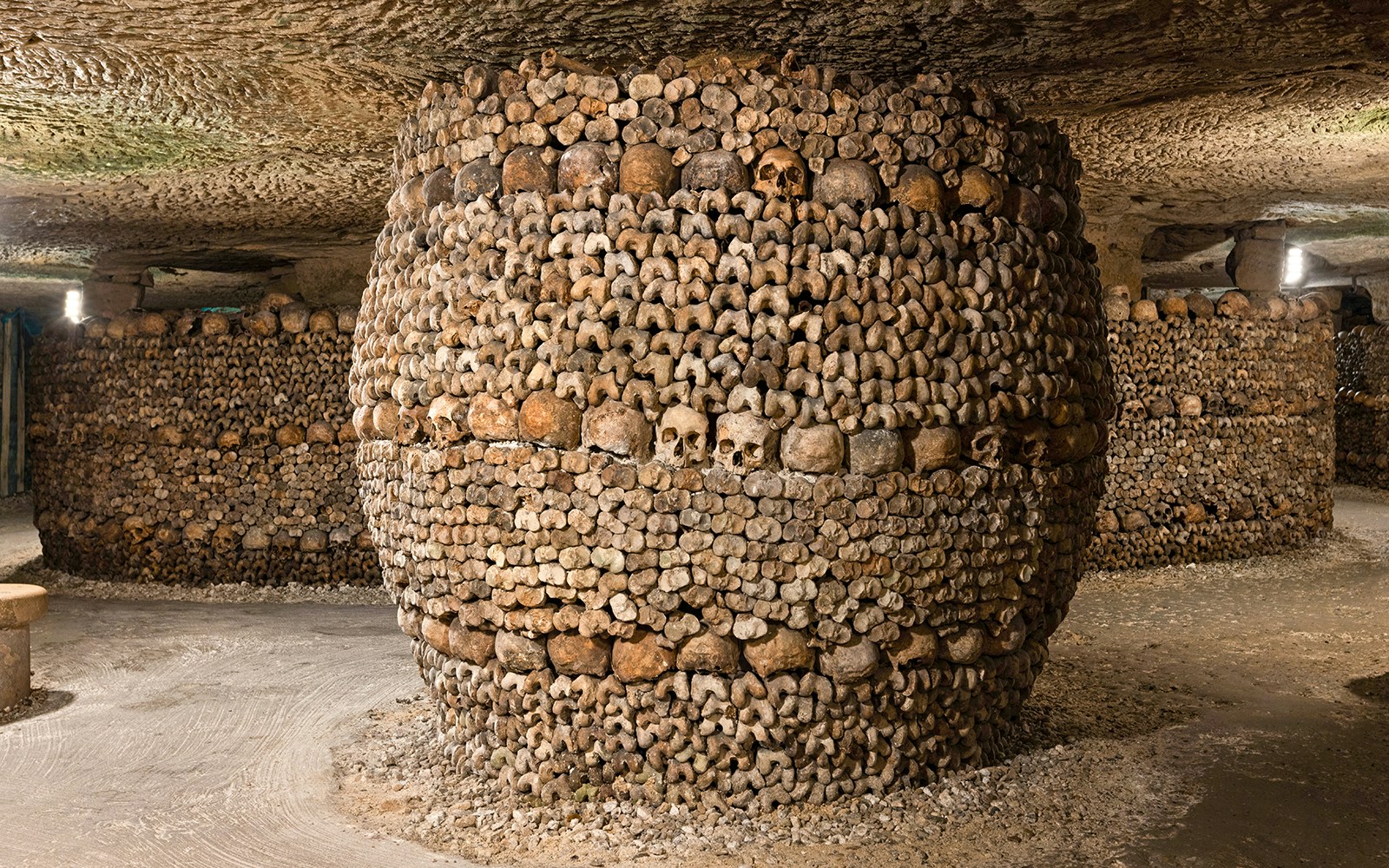
Crypt of Passions

This barrel-shaped structure, made of skulls and ankle bones, was meant to resemble Obelix from the cartoon Asterix and Obelisk.

Oil lamp

This lamp played a significant role in the safety of the quarrymen at work. A burning lamp meant there was oxygen in the air and an extinguished lamp meant there was no oxygen and it was time for the men to exit the underground.

“Stop, this is the Empire of Death” sign

The Well of the Footbath

The Rotunda of the Tibia Bones

Plaques on Revolutionary Events

Movies, books, and art

  • Movies: The Paris Catacombs have starred in films like As Above, So Below (2014), a supernatural thriller that takes viewers into its dark corridors, and Catacombs (2007), a horror movie centering on the mysterious underground.
  • Books: Victor Hugo’s Les Misérables includes a tense escape sequence through the Catacombs, while Gaston Leroux's The Phantom of the Opera draws on their mystique. Modern works like The Secret Catacombs by Rick Chesler also delve into their eerie atmosphere.
  • Art: The Catacombs have inspired haunting photography series and installations, including Philippe Auguste’s photos showcasing the ossuary as both morbid and poetic. Urban explorers and artists continue to document their uncharted tunnels.

Famous visitors and stories

  • Writers and explorers: Alexandre Dumas and Victor Hugo reportedly found inspiration for their works here; Napoleon III arranged for his son to tour the Catacombs, fascinated by their history.
  • Modern explorers: The Catacombs have become a playground for cataphiles (urban explorers), with some mapping hidden areas or hosting secret gatherings in the labyrinth.
  • Notable Stories: In 2004, French police discovered a secret cinema room complete with a bar and screening area, hidden deep within the Catacombs—a story that’s now legendary among explorers.

Urban legends and myths

  • The disappearing adventurer: Legends tell of explorers vanishing after getting lost in the maze, with mysterious recordings like the infamous Claustrophobic Tape fueling the myth.
  • Supernatural activity: Visitors have reported ghostly sightings and whispers from the walls, adding to the Catacombs’ reputation as one of the world’s most haunted places.
  • Secret societies: Myths of cults or secret organizations using hidden chambers for meetings and rave parties continue to fascinate.
  • The Gates to Hell: Some believe the Catacombs are an entryway to the underworld, a theory amplified by films and paranormal enthusiasts.

Frequently asked questions about Paris Catacombs

Originally stone quarries, Paris Catacombs were created in the late 18th century to relocate remains from overcrowded cemeteries and resolve sanitation issues in Paris.